ChatGPT vs AI Marketing Platforms: What Does Each Do Better?

ChatGPT helps marketers research, plan, write and analyse content. An AI marketing platform can connect these activities to tools for social media publishing, email campaigns, advertising and other marketing tasks.
For example, an online shop preparing a weekend sale can use ChatGPT to draft promotional emails, social media posts and ad copy. The team still needs to organise assets, verify prices, schedule publications, and coordinate the launch. A marketing platform with the relevant integrations can manage some of these tasks within a connected workflow.
The main difference lies in the work each tool supports and the steps required to complete a campaign.
|
Marketing task |
ChatGPT |
AI marketing platform |
|
Campaign planning |
Develops briefs, audience profiles and messaging ideas |
May connect campaign planning to execution workflows |
|
Content creation |
Drafts and revises copy across formats |
May generate content within a marketing workspace |
|
Social media publishing |
Requires a supported tool or integration to publish |
May schedule and publish content to connected accounts |
|
Email marketing |
Drafts email copy and subject lines |
May support campaign creation, scheduling and sending |
|
Advertising |
Develops ad copy, creative concepts and test ideas |
May connect to advertising accounts and support campaign management |
|
Workflow automation |
Helps design processes and instructions |
May execute supported recurring tasks |
|
Performance analysis |
Analyses supplied or accessible data |
May provide connected reporting and campaign management |
Capabilities vary by product, plan and integration. ChatGPT can also perform actions through supported tools, while some marketing platforms focus mainly on content generation.
ChatGPT is particularly useful for flexible tasks such as research, writing and developing campaign ideas. A marketing platform becomes more useful when a team needs to coordinate recurring tasks, manage connected accounts or reduce manual work between content creation and publication.

What ChatGPT Does Better for Marketing
ChatGPT is useful for tasks that require flexible instructions, drafting, analysis and repeated refinement. Marketers can provide context, request alternatives and revise the output through conversation.
Research and campaign planning
ChatGPT can help structure a campaign brief, identify customer objections, develop positioning options and turn product information into messaging themes.
For example, a SaaS company promoting a webinar could prepare different messages for existing customers, trial users and new prospects. Existing customers might receive an invitation focused on advanced product use, while new prospects receive one focused on the problem the webinar addresses.
The team should compare these messages with customer interviews, CRM insights and previous campaign results. AI-generated audience assumptions do not replace customer research.
Writing and editing marketing content
ChatGPT can draft blog posts, landing pages, email campaigns, social media captions, advertising headlines and product descriptions. It can also adapt copy to different audiences, formats and character limits.
For SEO, marketers can use ChatGPT to organise a content brief around search intent, suggest relevant headings, identify related concepts and develop FAQ ideas. Keyword volumes, ranking difficulty and current search results still require validation using SEO tools and live search data.
For example, a company selling accounting software could use ChatGPT to draft a product page, a comparison article and an email campaign. Although all three promote the same product, each needs a different structure, level of detail and purpose.
Output quality depends on the inputs. Product specifications, customer language, approved claims, brand requirements and examples of existing content give the model a stronger basis for drafting.
Comparing creative approaches
ChatGPT can produce alternative headlines, value propositions, calls to action and advertising concepts. Marketers can use these variations to prepare structured tests instead of relying on a single creative idea.
For example, a home renovation company could compare advertising messages focused on transparent pricing with messages focused on design support. The team could test each message against a relevant audience and measure the resulting enquiries.
ChatGPT can suggest what to test, but it cannot establish which message will perform better without relevant evidence. Results depend on the audience, offer, creative execution, targeting, landing page, and wording.
Analysing marketing data
With suitable reports or datasets, ChatGPT can summarise results, compare metrics, and identify patterns that need further investigation.
A marketing manager could provide a spreadsheet containing advertising spend, clicks, leads and cost per lead for several campaigns. ChatGPT could calculate comparisons and highlight differences for the team to investigate.
The team should verify calculations against the source data before changing budgets. ChatGPT also needs access to the relevant information: without a supplied report or supported connection, it cannot reliably assess live account performance. ChatGPT for marketing can support these tasks, from drafting campaign materials to analysing marketer-provided information.
What AI Marketing Platforms Do Better
A dedicated AI marketing platform helps when content needs to move through a repeatable process involving planning, review, scheduling, publishing, or campaign management.
Connecting content creation to publishing
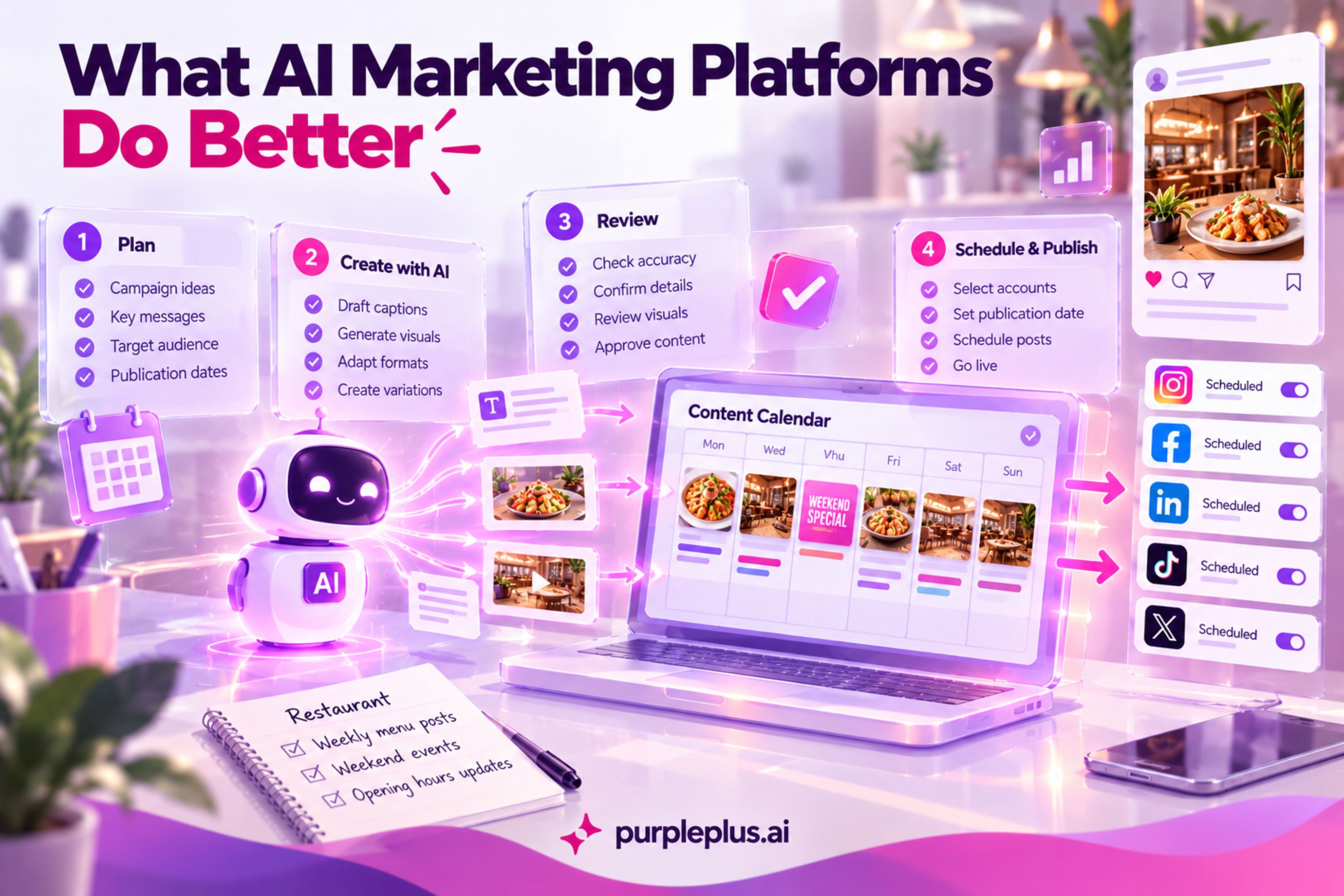
A social media post requires more than a caption. The team may need to prepare a visual, adapt the format, select an account, set a publication date, review the draft and confirm that the post is ready.
A platform with social media management features can bring supported steps into one workflow. Instead of transferring every asset manually between applications, marketers can organise content and scheduling in a shared workspace.
Consider a restaurant that publishes weekly menus, promotes weekend events and announces changes to opening hours. AI can help draft the messages, while a connected publishing tool can organise posts by date and account. Staff still need to verify time-sensitive details before publication.
The time saved depends on the available integrations and publishing permissions. A platform that generates captions but does not support the restaurant's accounts will not remove the scheduling work.
Managing recurring workflows
Marketing teams repeat tasks such as preparing weekly content calendars, reviewing drafts, coordinating approvals and organising campaign assets.
AI marketing automation can connect AI capabilities to recurring processes when the software supports the required actions. Depending on the platform, these may include scheduling, workflow controls, notifications and publishing.
For example, an agency managing five client accounts may need to collect drafts, obtain client approval and schedule posts every week. A shared workflow can make outstanding reviews and publication dates easier to track, provided the platform supports the required account structure and approval process.
Automation does not mean every step runs without supervision. Check whether the platform executes a task, prepares a recommendation or still requires a person to complete the action.
Coordinating multiple marketing channels
A campaign may require blog content, social posts, emails and paid advertisements. When each channel uses a separate tool, teams must transfer briefs, copy, visuals and updates between systems.
A connected platform can reduce this work by supporting the relevant channels and integrations. Teams can coordinate assets and campaign activities in one workspace instead of maintaining separate processes for every channel.
For example, an ecommerce brand launching a new product could prepare a landing page, email announcement, social posts and advertising creatives from the same campaign brief. Each asset still needs channel-specific formatting, links and approvals, but a shared workflow can help maintain consistent product details and launch dates.
Check which accounts are supported and what each integration can do. For example, a connection to an advertising platform does not necessarily provide access to every campaign setting or optimisation feature.
Reducing manual handoffs
Marketing work often involves administrative steps: copying content into another application, sending files for approval, updating a calendar and checking publication status.
A platform can reduce these handoffs by connecting supported tasks and keeping workflow status visible. This can be particularly useful when several people contribute to a campaign or when the same process runs every week.
For example, a team can track draft status, reviewer assignments and publication dates in one place instead of chasing updates through email and spreadsheets. The platform will not resolve delays caused by unclear responsibilities or missing approvals, so the workflow still needs defined owners and deadlines.
Purple+ brings supported marketing activities into a connected workspace, including content planning, social media workflows and marketing automation. Its suitability depends on whether the available features and integrations match the team's process.
ChatGPT vs AI Marketing Platforms: Which Is Better for Each Task?
The better option depends on the work involved, the tools you already have, and how much manual coordination you need.
Writing a blog post
ChatGPT is useful for developing an outline, drafting sections, revising copy and generating headline alternatives. A marketing platform may be more useful when blog production forms part of a broader workflow involving content planning, review and publication.
For example, a content marketer can use ChatGPT to draft an article, then manage the editor's review, internal links, publication date and promotional assets through a content workflow.
Neither tool removes the need to verify facts, assess search intent, add original expertise and check the final page.
Planning and publishing social media
ChatGPT can generate content ideas, write captions and adapt messages for different platforms. A content calendar created in a conversation does not automatically become a live publishing schedule.
A platform with connected accounts, scheduling and publishing features is better suited to managing recurring posts. How much ChatGPT can manage your social media depends on the tools, permissions, and actions available in the setup.
For example, a consultant could ask ChatGPT to draft five LinkedIn posts for the week. Publishing those posts at the right times still requires a scheduling process or a supported integration that can do it.
Creating and managing advertisements
ChatGPT can develop ad copy, creative briefs, headline variations and testing hypotheses. Launching or modifying a live campaign requires the relevant account access and a tool that supports those actions.
A marketing platform with suitable advertising integrations may support campaign execution or monitoring. The team should verify whether it can create campaigns, change budgets, manage targeting or only assist with content.
For example, a business promoting a seasonal offer could use ChatGPT to draft several ad variations. Before launch, the team still needs to check the offer dates, landing page, targeting, budget and campaign settings. A connected tool may handle supported execution steps, but its capabilities depend on the integration.
Coordinating a multi-channel campaign
ChatGPT can turn a campaign brief into draft content for social media, email, ads and a website. A connected platform can help organise those assets, coordinate reviews and schedule supported activities.
This matters when campaign tasks depend on one another. An email should not announce a discount before the landing page is ready, and a social post should not promote a product that is unavailable.
A shared campaign workflow can help teams coordinate dates and approvals. ChatGPT can prepare the content and flag possible inconsistencies, but the team needs a reliable process to manage publication.
Reviewing performance
ChatGPT can analyse supplied campaign reports and help interpret changes in cost, clicks, conversions or engagement. A marketing platform may make performance data easier to access alongside campaign activity if it connects to the relevant accounts.
For example, a team could compare two lead-generation campaigns by cost per qualified lead rather than clicks alone. ChatGPT can help analyse the report, while connected reporting software may reduce the work involved in gathering the figures.
Neither tool guarantees better results. Reliable optimisation requires accurate data, appropriate metrics and tests that reveal meaningful differences.
Can You Use ChatGPT and an AI Marketing Platform Together?
Yes. ChatGPT can support research, planning, writing and analysis, while a marketing platform connects that work to the tools used to run campaigns.
A product launch provides a practical example:
-
Prepare the brief. Define the audience, offer, objective and key message.
-
Draft the assets. Create social posts, email copy, blog content and advertising variations using verified product information.
-
Organise the work. Place assets in the relevant content calendar or workflow and assign review steps.
-
Approve the content. Check claims, links, visuals, brand consistency and channel requirements.
-
Publish and measure. Use connected tools to publish approved content and review available campaign data.
This setup separates content development from campaign execution. ChatGPT helps produce and refine the assets; the marketing platform manages the operational steps it supports. The exact process depends on the platform, integrations and permissions.
Purple+ supports connected workflows through compatible AI assistants such as ChatGPT, Claude and Gemini - available actions depend on the connected environment, account permissions and supported integrations. Teams should confirm that the required action is available before relying on it in a production workflow.
How to Choose an AI Marketing Platform
Compare platforms against the work your team needs to complete, not the number of AI features advertised.
Identify the main bottleneck
List the tasks that consume the most time: writing, preparing visuals, transferring assets, coordinating approvals, scheduling posts or compiling reports.
If the main problem is drafting and editing, ChatGPT may cover much of the need. If the bottleneck is coordinating recurring activities across several tools, look for a platform that supports those tasks directly.
A small business that publishes occasionally on one social account may not need a separate marketing platform. A business publishing daily across several channels may benefit from centralised scheduling and workflow controls. The difference comes down to the volume and complexity of the work.
Verify integrations and supported actions
Check whether the platform connects to your actual social accounts, advertising networks, email software and website systems.
Confirm what each integration can do. Account connectivity does not automatically mean the platform can publish every content format, launch every campaign type or modify all settings.
Ask practical questions: Can it schedule the content formats you use? Can team members approve drafts? Does it support the advertising actions you need? Can it retrieve the performance data required for reporting? These answers matter more than a broad claim of AI-powered automation.
Compare the total cost
Compare subscription fees with the cost of the full workflow, including other software, setup, training and administration. A lower-cost writing tool may still require separate applications for scheduling, design, email and reporting.
When comparing AI marketing software pricing, include the staff time needed to transfer content, maintain integrations and check outputs. The useful comparison is the total cost of completing the work, not the price of one subscription in isolation.
A platform is cost-effective only if its useful features offset the subscription and implementation costs. Paying for functions the team rarely uses does not create savings.
Set review and approval requirements
Decide which actions require human approval before connecting accounts or enabling automation. Product claims, prices, regulated statements, customer communications and advertising budget changes may need stricter controls than routine content formatting.
For example, a team may schedule approved evergreen posts in advance but require manual review for price changes, product launches and time-sensitive promotions.
The platform should support the level of control the business needs. Do not assume that automated workflows include the approval rules required by your organisation.
Measure the results
Record the current time and cost required to complete recurring tasks. After implementation, compare production time, approval delays, publishing errors and manual handoffs.
Measure leads, conversions and revenue separately. Faster content production is an operational improvement, but it alone doesn't show better marketing performance.
You could track how long it takes to prepare and publish a week's social content before and after introducing a platform. The team could also track missed publication dates, corrections, and approval delays to see whether the new process improves reliability.
ChatGPT vs AI Marketing Platforms: The Practical Choice
ChatGPT suits research, writing, analysis, and campaign planning. An AI marketing platform is useful for the execution and coordination tasks its integrations explicitly support, including content scheduling, publishing and connected marketing workflows.
Businesses can use both. A general AI assistant can help develop and refine the work, while marketing software can reduce the manual steps required to put approved content into use.
Compare the platform with your current workflow, the channels you use and the time spent moving work between tools.
Frequently asked questions
Written by
AI & SEO Content writer
Tetiana Reusche is an SEO Content Strategist and AI marketing specialist who specialises in creating content that helps businesses improve their online visibility and turn organic traffic into business growth. Her work combines search strategy, content marketing, and AI-driven optimisation to produce content that performs across search engines, answer engines, and modern AI-powered discovery platforms. Over the years, she has developed SEO strategies and content frameworks for companies in the SaaS, software, miltech, travel, real estate, home renovation, lifestyle, and entertainment industries. She enjoys translating complex topics into practical, engaging content that is valuable for both readers and search engines. Tetiana focuses on building topical authority through strategic keyword research, content planning, search intent analysis, and well-structured content ecosystems. She regularly creates keyword clusters, content recommendations, editorial roadmaps, and SEO strategies that help brands reach the right audience, strengthen their authority, and generate meaningful business results. Her articles explore SEO, AI-powered marketing, social media management, content strategy, and digital growth, with a practical focus on helping businesses create discoverable, useful content designed to convert.