
AI Content Repurposing vs Creating Content from Scratch

AI Content Repurposing vs Creating Content from Scratch: Which Approach Works Best?
Marketing teams face a recurring decision: should they turn existing material into new content or create something entirely new?
Repurposing can help businesses get more value from blog articles, webinars, customer questions, research and campaign assets. Creating content from scratch gives teams more freedom to address new topics, respond to changing customer needs and develop original ideas.
Neither approach works for every situation. Repurposing content that no longer reflects the business wastes time, while creating every asset from scratch duplicates work the team has already completed.
AI makes both processes faster. It can extract key ideas, restructure existing material, generate new drafts and adapt content for different channels. The important decision is knowing when to reuse existing information and when the topic needs a fresh approach.
What Is AI Content Repurposing?
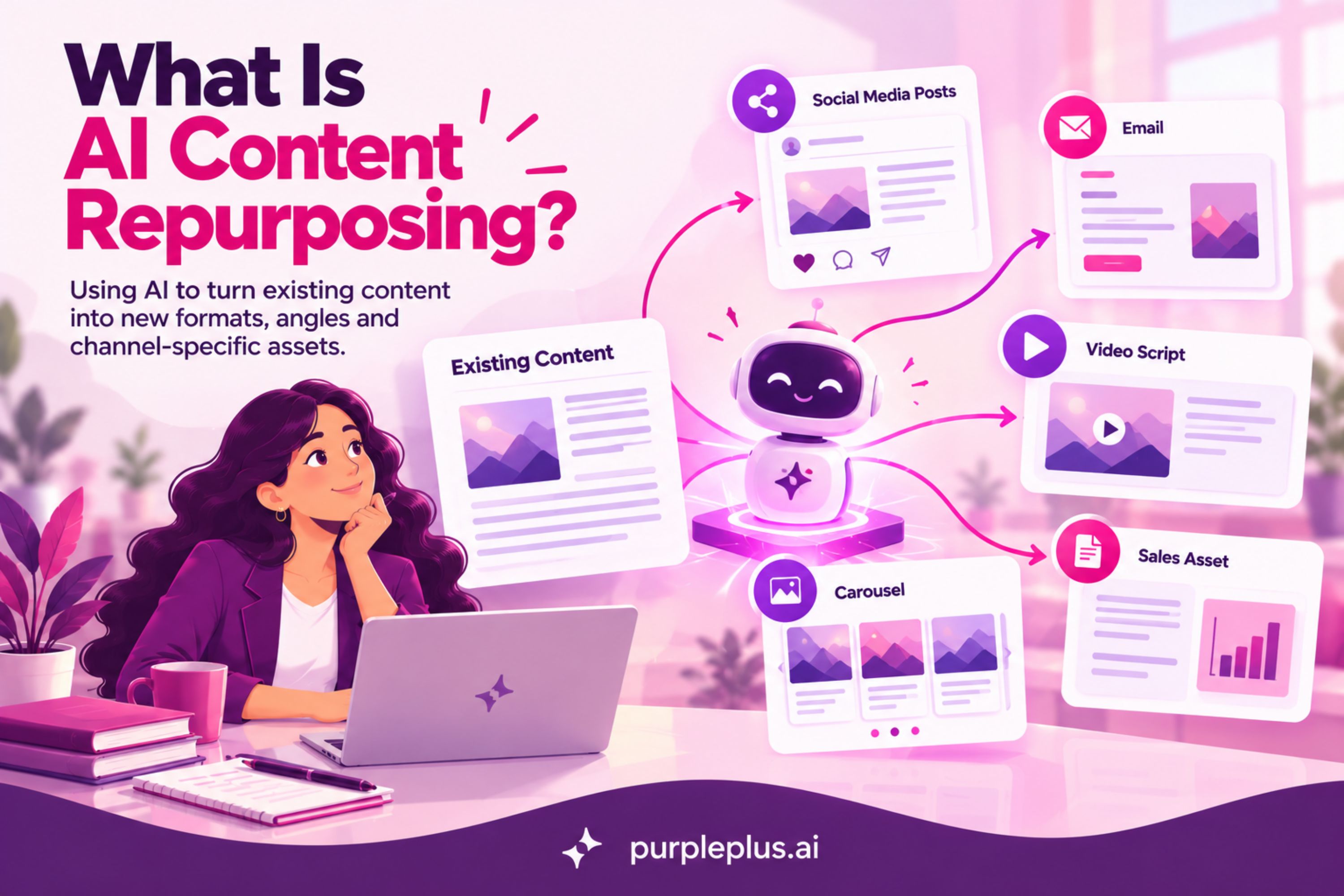
AI content repurposing means using artificial intelligence to transform existing material into new content formats, angles or channel-specific assets.
For example, a business could use an existing article about reducing customer acquisition costs to develop:
-
Several social media posts, each covering a different takeaway.
-
An email highlighting the article's most useful recommendation.
-
A short video script explaining one of its key points.
-
A carousel presenting the main steps visually.
-
A sales enablement asset addressing a related customer question.
The source material provides the factual foundation. AI helps extract ideas, restructure information and adapt the wording to the intended audience and format.
Effective repurposing requires more than shortening an article or changing a few words. Each new asset should serve a clear purpose and offer value in its own format.
For example, a LinkedIn post can explore one business implication in detail, while an Instagram carousel might present a practical sequence of steps. Both can use the same source material without repeating the same message verbatim.
What Does Creating Content from Scratch Involve?
Creating content from scratch starts with a new topic, question, audience need, or campaign objective, not an existing content asset.
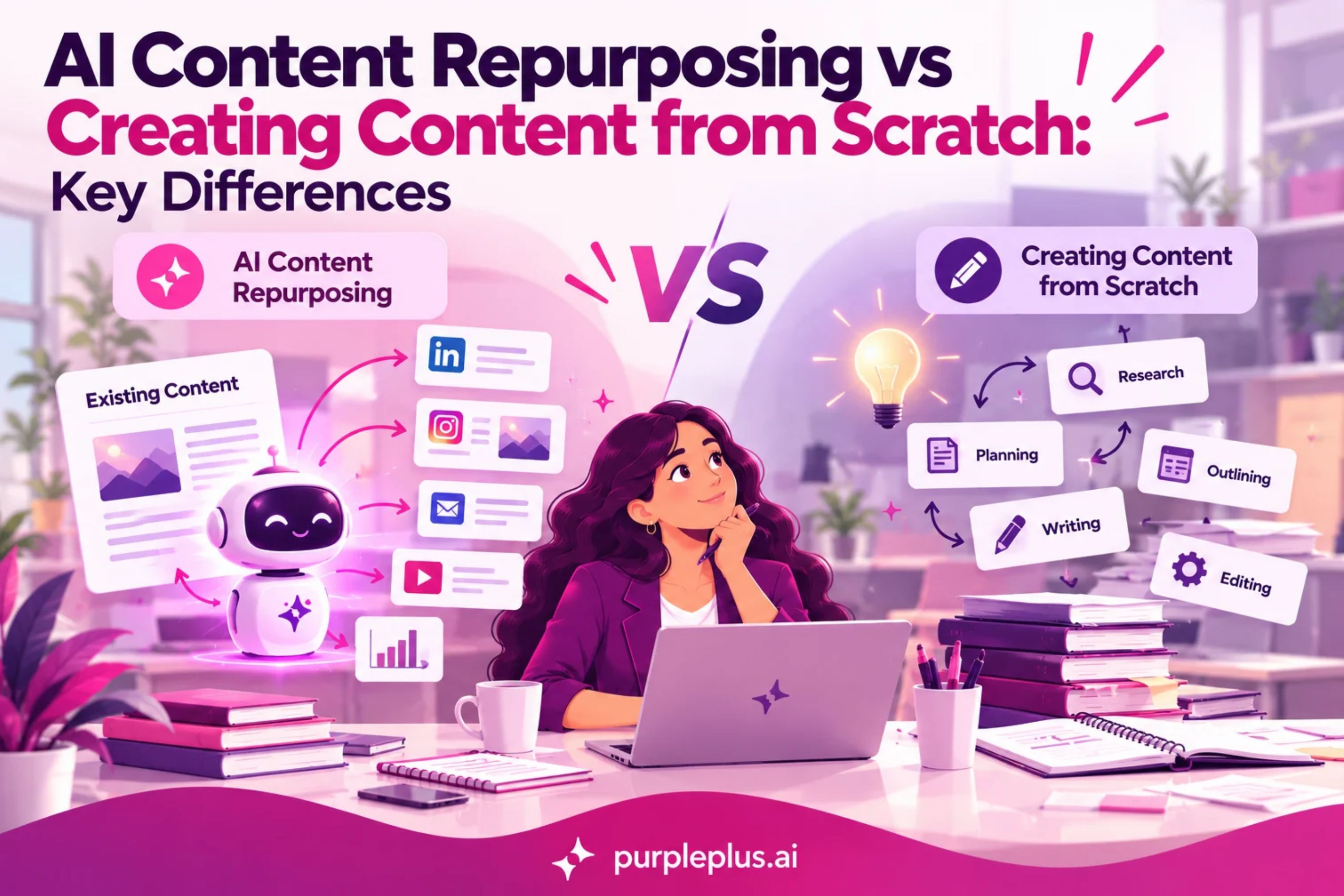
The process may involve research, interviews, customer feedback, keyword analysis, outlining, drafting, editing and fact-checking. AI can support these tasks, but the team still needs to provide accurate information and decide the content's purpose.
This approach is useful when a business needs to:
-
Address a search query its current content does not answer.
-
Publish original research or findings.
-
Explain a new product, service or company development.
-
Respond to a new customer problem or industry change.
-
Develop a distinct campaign concept.
-
Replace outdated material that no longer reflects current practices.
Creating from scratch does not mean ignoring existing knowledge. Previous articles, customer questions and research can inform the new piece. The difference is that the new asset requires its own substantive content rather than relying mainly on an existing piece.
AI Content Repurposing vs Creating Content from Scratch: Key Differences
The main difference lies in the starting point, the work required and the value each approach can deliver.
|
Factor |
AI content repurposing |
Creating content from scratch |
|
Starting point |
Existing articles, research, videos or campaign assets |
A new topic, brief, question or objective |
|
Research |
Uses existing material, with additional checks where needed |
Usually requires more topic-specific research |
|
Production time |
Often shorter when the source is relevant and accurate |
Often longer when the topic requires substantial research |
|
Originality |
Depends on the new angle, format and additional insight |
More freedom to develop a distinct argument or approach |
|
Best use |
Extending useful material across channels |
Covering new needs, information gaps and original ideas |
|
Main risk |
Repetition, outdated claims or superficial variations |
Duplicated research, generic content or unnecessary production work |
|
AI's role |
Extracts, adapts, restructures and creates variations |
Supports research, outlining, drafting and editing |
The time difference depends on the task. Turning a well-researched article into several social posts may take considerably less effort than producing an original research report. However, repurposing a long article with outdated data can require substantial verification and rewriting.
When Should You Repurpose Existing Content?
Repurposing works best when the original material remains accurate, useful and relevant to the intended audience.
1. You Have Useful Content That Reaches Too Few People
A detailed blog post may attract organic traffic but receive little attention on social media. A webinar may contain several valuable insights that never appear outside the recording.
AI can help identify distinct ideas within these assets and adapt them for other channels. This gives the original material more opportunities to reach people who prefer different formats.
Before repurposing, check which parts offer independent value. One strong article may support several assets, but each asset needs a specific message rather than a rewritten introduction.
2. You Need More Content Without Repeating the Research
Some topics support multiple useful formats. An article about onboarding customers, for example, could provide the foundation for a checklist, an email series and social posts about common onboarding mistakes.
The research does not need to be repeated for every asset. Instead, the team can verify the source material once, identify separate takeaways and adapt them to each format.
This approach is particularly useful for small marketing teams managing multiple channels with limited production capacity.
3. You Want Consistent Campaign Messaging Across Channels
Campaigns often require social posts, emails, landing-page copy and advertising assets that communicate the same core offer.
Repurposing approved campaign material helps keep facts, terminology, and positioning consistent. AI can generate variations for different audiences or channels, while marketers review each version for relevance and accuracy.
For teams managing multiple social platforms, a connected workflow for cross-platform social media publishing can help coordinate adapted content and publication.
When Is Creating Content from Scratch the Better Choice?
Repurposing shouldn't become an excuse to recycle material that no longer answers the audience's question.
1. The Audience Has a New Question
An existing article may cover the general topic but fail to answer a new, more specific question. Rewriting the article into another format will not solve that gap.
Start by examining the actual question, the information required to answer it and the evidence available. Existing material can provide background, but the new asset should address the missing information directly.
For AI SEO content, this distinction matters. A new page should have a clear search intent and provide information that existing pages do not already satisfy.
2. The Topic Requires New Evidence
Some content depends on current pricing, product specifications, regulatory changes, original research or recent customer feedback.
In these cases, the team needs to gather and verify the relevant information before drafting. AI can help organise the research and prepare the content, but it should not fill evidence gaps with invented facts or unsupported claims.
3. The Original Content No Longer Reflects the Business
Products change, services expand, and customer expectations shift. An older article may contain recommendations that are no longer appropriate.
A substantial update can sometimes solve the problem. In other cases, a new asset with a different purpose or argument will be more useful.
The decision should depend on what the audience needs now, not simply on whether the business already has a page about the subject.
How to Decide Between Repurposing and Creating New Content
Use the following decision process before assigning work to a writer or an AI content tool.
Step 1: Define the content objective.
Identify the question the asset should answer, the audience it should reach and the action it should support. A clear objective prevents the team from producing content simply to fill a publishing calendar.
Step 2: Audit existing material.
Search current articles, landing pages, videos, webinars, emails and campaign assets. Look for material that contains accurate information relevant to the objective.
Step 3: Identify the information gap.
Compare the existing material with the intended asset. If the source already contains the necessary facts and insights, repurposing may be appropriate. If essential information is missing, gather it before deciding how to produce the content.
Step 4: Estimate the full production effort.
Account for research, drafting, editing, fact-checking, approvals and channel adaptation. Repurposing is not automatically faster if the source needs extensive correction.
Step 5: Choose the approach and review the result.
Repurpose the material if it supports a useful new asset. Create new content if the audience needs information or analysis the source cannot provide. In both cases, review the final output for accuracy, originality and relevance.
A hybrid approach often works best: reuse verified information where it helps, then add new research, examples or analysis where the topic requires it.
How AI Can Make Both Content Workflows More Efficient
AI is useful for different tasks in each workflow. Its value depends on the quality of the source material, the instructions and the review process.
AI for Content Repurposing
AI can help marketers:
-
Extract distinct ideas from long-form content.
-
Identify potential content formats for different channels.
-
Adapt tone, length and structure to a platform.
-
Generate alternative headlines and calls to action.
-
Turn a core message into several audience-specific versions.
-
Identify repeated points across proposed assets.
The team should supply the source material, audience, channel requirements and intended outcome. It should also check that the new asset does not distort the original meaning or repeat an existing page without adding value.
AI for Creating New Content
For new content, AI can help organise research notes, develop outlines, draft sections, refine language and identify missing questions.
It can also help turn a brief into a structured production plan. However, the quality of the result depends on the information available. Original analysis, expert knowledge, customer evidence and factual verification remain important when the topic calls for them.
For more structured drafting and editing workflows, ChatGPT prompts for marketing writing can help teams define the audience, content objective, format and editorial requirements before generating a draft.
Connect Content Creation to Planning and Publishing
Producing more drafts does not necessarily improve marketing performance. Teams also need to organise assets, assign reviews, maintain publishing schedules and evaluate results.
A connected process can move content from creation to review and publication without requiring marketers to track every step manually. Purple+ combines AI-assisted content creation with content planning and marketing workflows, helping teams coordinate content production and distribution.
The objective is not to repurpose everything or automate every task. It is to reduce avoidable work while protecting content quality and giving each asset a clear role.
How to Measure the Value of Repurposed and Original Content
The number of assets produced is a weak measure of success on its own. Measure each asset against its intended purpose.
Useful metrics include:
-
Production time: How long does the team spend researching, drafting, editing and approving each asset?
-
Cost per published asset: What does production cost after accounting for internal time and external support?
-
Engagement: Do people interact with the content in ways that matter for the channel?
-
Qualified traffic: Does the content attract visitors who match the intended audience?
-
Conversions: Does it contribute to relevant actions, such as sign-ups, enquiries or purchases?
-
Content reuse rate: How much useful source material can the team adapt without producing repetitive or low-value assets?
-
Maintenance effort: How much work is required to keep repurposed information accurate over time?
Compare assets with similar objectives and audiences. A short social post and a detailed SEO article serve different purposes, so you shouldn't judge their results by the same metric alone.
Common Mistakes in AI Content Repurposing
Repurposing saves time only when the resulting content remains useful. Several mistakes can undermine the process.
Changing the format without changing the approach. Copying an article into a social post rarely produces platform-suited content. Extract a specific takeaway and rebuild the asset around it.
Publishing too many similar variations. Multiple assets should not repeat the same point with minor wording changes. Give each one a distinct angle, question or practical purpose.
Using outdated source material. Check figures, product details, recommendations and other time-sensitive claims before adapting them.
Ignoring search intent. A new SEO page should satisfy a distinct audience need. Rewriting an existing article for a closely related keyword can create duplication rather than meaningful coverage.
Removing human review. AI can introduce inaccuracies, flatten brand voice or misrepresent the original argument. Assign responsibility for checking each asset before publication.
Measuring output instead of outcomes. Producing 20 assets instead of five is not an improvement if the additional content attracts no relevant attention or creates more maintenance work.
A controlled workflow makes it easier to reuse valuable information without turning the content library into a collection of near-duplicates.
How Purple+ Supports AI-Assisted Content Production
Purple+ brings AI-assisted content creation together with marketing workflows that help teams organise, adapt and distribute content.
This can support businesses that need to create new material while making better use of existing assets. Teams can create content variations, plan social publishing, and coordinate activities across marketing channels instead of treating every asset as a separate task.
The benefit depends on the team's workflow, connected channels and review requirements. AI can reduce repetitive drafting and adaptation, but marketers still need to choose the right topics, verify claims and decide which assets deserve publication.
For a small team, start simple: identify one recurring content task, assess how much time it takes, and test whether AI-assisted creation or repurposing improves the process without sacrificing quality.
Frequently asked questions
Written by
AI & SEO Content writer
Tetiana Reusche is an SEO Content Strategist and AI marketing specialist who specialises in creating content that helps businesses improve their online visibility and turn organic traffic into business growth. Her work combines search strategy, content marketing, and AI-driven optimisation to produce content that performs across search engines, answer engines, and modern AI-powered discovery platforms. Over the years, she has developed SEO strategies and content frameworks for companies in the SaaS, software, miltech, travel, real estate, home renovation, lifestyle, and entertainment industries. She enjoys translating complex topics into practical, engaging content that is valuable for both readers and search engines. Tetiana focuses on building topical authority through strategic keyword research, content planning, search intent analysis, and well-structured content ecosystems. She regularly creates keyword clusters, content recommendations, editorial roadmaps, and SEO strategies that help brands reach the right audience, strengthen their authority, and generate meaningful business results. Her articles explore SEO, AI-powered marketing, social media management, content strategy, and digital growth, with a practical focus on helping businesses create discoverable, useful content designed to convert.