ChatGPT for Marketing: Practical Uses for Marketers

ChatGPT can support many marketing tasks, from research and content development to campaign planning, SEO, email marketing and reporting. Its value depends on how you use it: ChatGPT can process information, generate drafts, analyse supplied data, and structure ideas, but marketers still need to provide context and verify important outputs.
For marketers, the most useful applications are tasks where language, research synthesis, structured thinking, or repetitive content work take significant time. The tool becomes less reliable when a task depends on current data, private business information or decisions that require direct access to marketing platforms.
What Is ChatGPT for Marketing?
ChatGPT for marketing means using ChatGPT to assist with marketing research, planning, content production, analysis and communication.
The tool can work with information supplied by a marketer and produce different types of output, including:
-
research summaries
-
audience profiles
-
content briefs
-
keyword ideas
-
email drafts
-
social media copy
-
advertising concepts
-
campaign structures
-
reports
-
data analysis
-
marketing workflows
The quality of the result depends heavily on the information provided. A prompt that includes the target audience, product, positioning, objective, source material, and output requirements gives ChatGPT much more useful direction than a generic request such as "write a marketing plan."
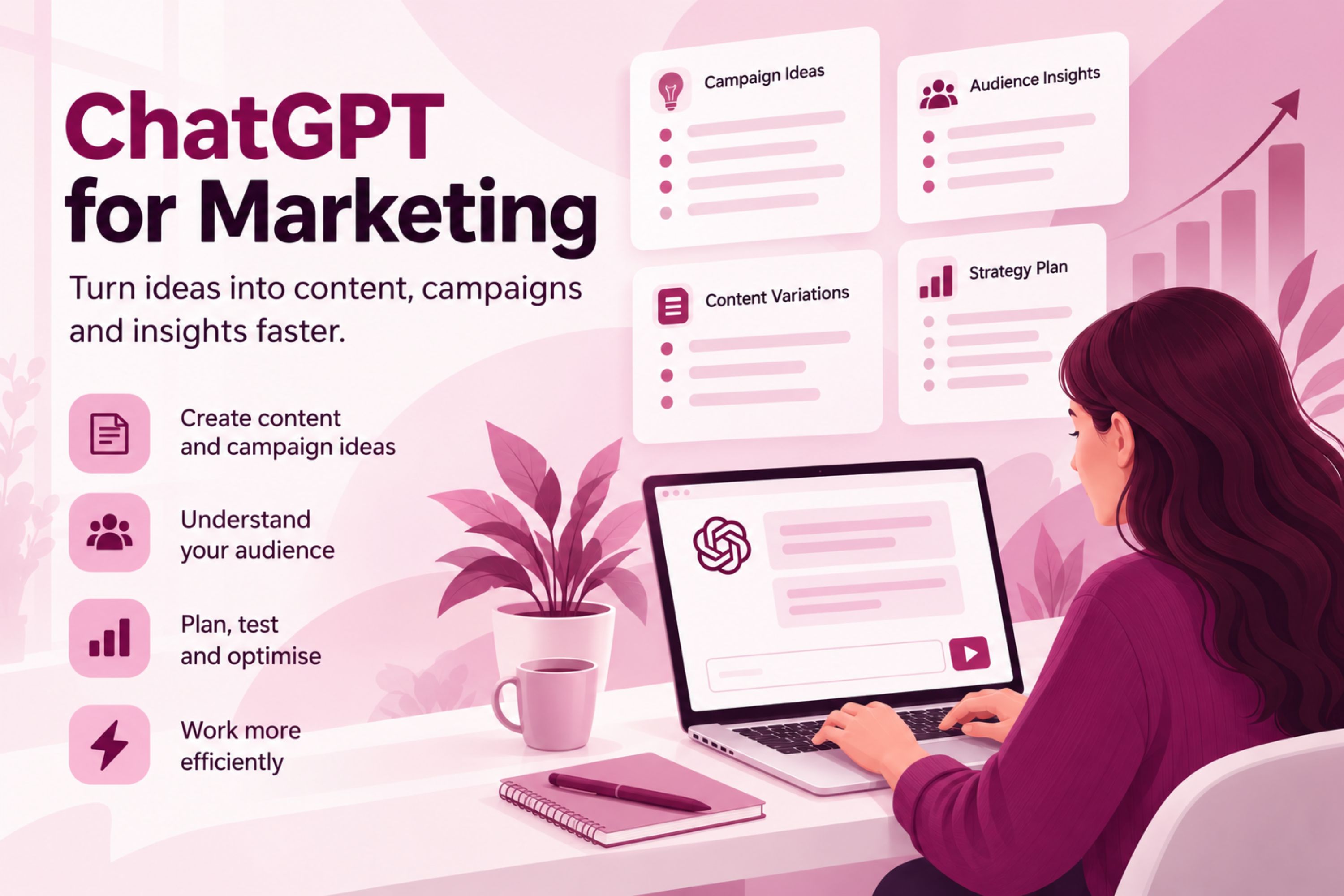
How ChatGPT Helps Marketers
How you use ChatGPT depends on the stage of the marketing process.
It can help marketers move from raw information to a structured output faster. For example, customer interviews can be turned into recurring themes, a product brief can become a content plan, and campaign data can be summarised into questions for further analysis.
This makes ChatGPT for marketers particularly useful for research, drafting, restructuring, ideation and analysis.
It should not be treated as an independent source of market truth. Check information generated by ChatGPT when accuracy, freshness, or business consequences matter.
ChatGPT for Marketing Research
Marketing research often involves collecting information from different sources and turning it into usable findings.
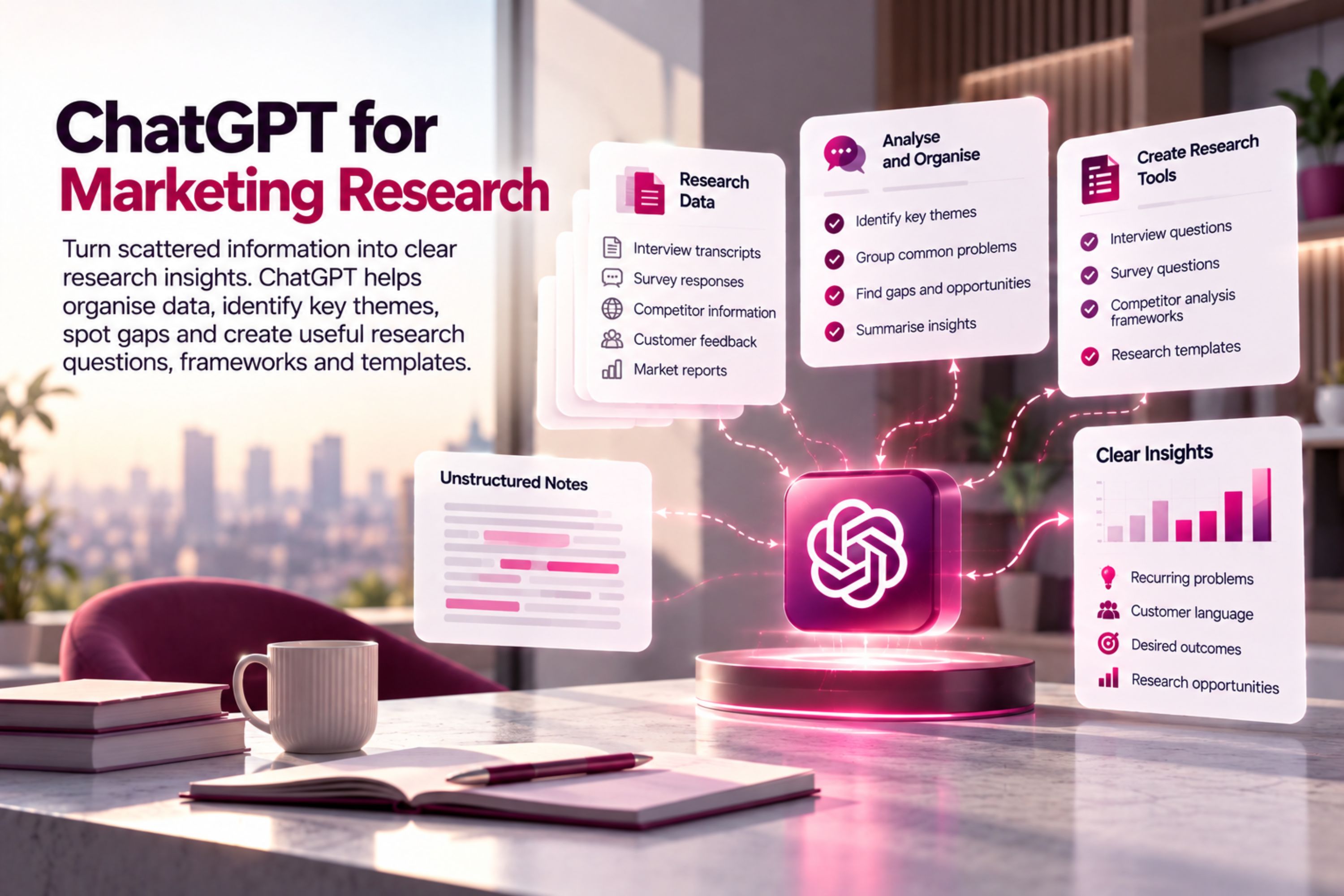
ChatGPT can help organise supplied research, compare themes, identify gaps and convert unstructured notes into structured research questions. It can also help marketers create interview questions, survey questions, competitor-analysis frameworks and customer-research templates.
For example, a marketer could provide customer interview transcripts and ask ChatGPT to group recurring problems, objections, desired outcomes and language customers use to describe the problem.
The important distinction is between analysing research and creating research evidence. ChatGPT can help process collected information, but you should not treat its generated assumptions as customer research.
ChatGPT for Customer Research
Customer research becomes more useful when it reveals how people describe their needs, objections and buying criteria.
ChatGPT can analyse supplied customer feedback and organise it into categories such as:
-
customer problems
-
product expectations
-
objections
-
purchase motivations
-
frequently mentioned features
-
language used by customers
-
unresolved issues
This can help marketers identify themes that can later inform positioning, content and campaign messaging.
ChatGPT should not be asked to invent customer opinions and then treated as if those opinions came from real customers. The source material needs to come from actual reviews, interviews, surveys, support conversations or other valid customer data.
ChatGPT for Marketing Strategy
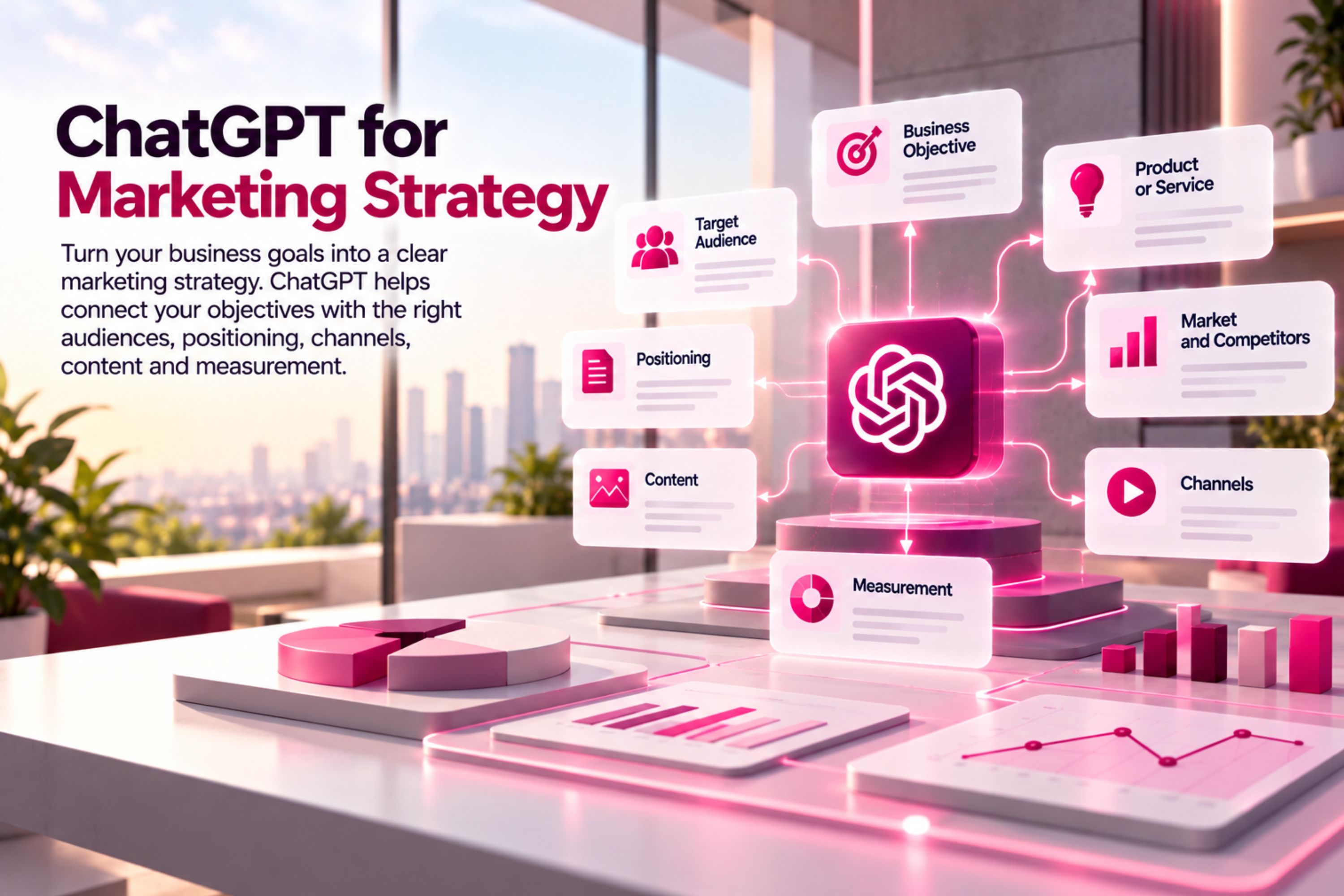
ChatGPT can help structure a marketing strategy by connecting a business objective with audiences, positioning, channels, content and measurement.
A useful strategy prompt can include:
-
Business objective
-
Product or service
-
Target audience
-
Market
-
Competitive context
-
Existing marketing channels
-
Available resources
-
Commercial constraints
-
Desired outcome
ChatGPT can then help identify strategic options, gaps and questions that require further investigation.
It is more useful as a strategic working tool than as a substitute for market knowledge. A generated strategy can organise decisions, but it cannot independently validate demand, pricing, competitive positioning or customer behaviour.
ChatGPT for Content Marketing
Content marketing is one of the most practical applications of ChatGPT because much of the work involves research, outlining, drafting, editing and adapting information for different formats.
ChatGPT can help marketers:
-
develop content briefs
-
create article structures
-
expand research notes
-
rewrite existing copy
-
adapt content for different audiences
-
generate headline variations
-
turn long-form content into shorter formats
-
identify content gaps
-
create content calendars
The strongest workflow starts with source material and a clear content objective.
Instead of asking ChatGPT to "write a blog," a marketer can provide the target audience, search intent, keyword set, existing page structure, source material, required terminology and editorial constraints.
That produces a more controlled result and reduces generic wording.
ChatGPT for SEO
ChatGPT for marketing can also support SEO tasks, particularly where the work involves language and content structure.
Useful applications include:
-
keyword clustering
-
search-intent analysis
-
content briefs
-
heading structures
-
title and meta description ideas
-
internal-link suggestions
-
content gap analysis
-
FAQ development
-
semantic keyword expansion
-
rewriting and content optimisation
ChatGPT can help identify relationships between keywords, topics and search intents, but keyword volume and current search results should come from reliable SEO data rather than assumptions generated by the model.
For existing pages, giving ChatGPT the actual content and target keyword set produces a more useful optimisation workflow than asking for generic SEO advice.
ChatGPT for Email Marketing
ChatGPT can support email marketing at several stages, including planning, drafting and personalisation.
Marketers can use it to create:
-
campaign concepts
-
subject-line variations
-
email body copy
-
welcome sequences
-
promotional emails
-
follow-up messages
-
customer segments
-
email testing variations
The input should include the audience, offer, customer relationship, desired action and brand voice.
ChatGPT can also adapt one core message for different customer segments. However, personalisation should be based on real customer attributes or behavioural data, not invented details.
ChatGPT for Social Media Marketing
Social media teams can use ChatGPT to adapt ideas into platform-specific content.
For example, a single product announcement can be transformed into different formats for LinkedIn, Instagram, Facebook or other channels. ChatGPT can also generate post variations, hooks, captions, content themes and responses to common questions.
The value comes from adaptation, not producing large volumes of generic posts.
A social media workflow should still account for the platform, audience behaviour, brand voice, campaign objective and available creative assets.
ChatGPT for Advertising
ChatGPT can help marketers develop advertising concepts, copy and campaign structures.
It can generate:
-
headline variations
-
descriptions
-
ad copy
-
creative concepts
-
audience messaging
-
calls to action
-
testing variations
-
campaign themes
For Google Ads specifically, ChatGPT Google Ads can help with campaign planning, keyword organisation and ad-copy development. It can also help analyse advertising information the marketer supplies.
ChatGPT does not automatically have access to a live advertising account, even though it can generate advertising recommendations. Account-level performance, bids, budgets and campaign settings need to come from the relevant advertising platform or connected system.
ChatGPT and Marketing Campaign Planning
ChatGPT and marketing work well together when marketers use the model to structure campaign decisions.
A campaign brief can be broken into:
Objective → audience → proposition → message → channel → creative → landing page → measurement
ChatGPT can help identify missing information at each stage and produce campaign assets from an approved strategy.
It can also generate multiple messaging directions for testing rather than forcing marketers to settle on the first idea.
The final campaign still needs to be evaluated against commercial objectives, available resources and actual performance data.
ChatGPT in Marketing Analytics
ChatGPT can help analyse marketing data when you supply it in a usable format.
For example, a marketer can provide campaign results and ask the model to identify:
-
major changes
-
unusual patterns
-
differences between segments
-
underperforming areas
-
relationships between metrics
-
questions requiring further investigation
This can make large datasets easier to interpret.
However, ChatGPT should not turn correlation into a causal conclusion without evidence. If conversion rates changed after a campaign adjustment, for example, that doesn't automatically prove the adjustment caused the change.
ChatGPT for Marketing Reporting
Marketing reporting often requires turning multiple metrics into a concise explanation of what happened.
ChatGPT can help structure reports around:
-
campaign performance
-
traffic
-
leads
-
conversions
-
acquisition costs
-
revenue
-
channel performance
-
changes from the previous period
A useful reporting prompt should include the reporting period, business objectives, relevant benchmarks and the actual data.
The model can then summarise the results and highlight questions for further analysis, rather than repeating every metric in the dataset.
ChatGPT for Lead Generation
ChatGPT can support lead generation by helping marketers develop messaging, qualification questions and outreach materials.
Applications include:
-
lead-magnet ideas
-
landing-page copy
-
lead qualification questions
-
outreach sequences
-
prospecting-message variations
-
content for different buyer stages
-
follow-up emails
It can also help map content to different stages of the buying process.
Lead-gen quality still depends on targeting and the underlying offer. Generating more messages does not necessarily generate more qualified leads.
ChatGPT for Personalisation
ChatGPT can adapt marketing messages when marketers provide legitimate customer or segment information.
For example, a business could create different versions of a message for new customers, existing customers and high-value accounts.
Personalisation can involve:
-
messaging
-
examples
-
product recommendations
-
customer-stage language
-
offers
-
content format
The model should not be given unnecessary sensitive personal information simply to make a message appear more personalised. The data used should be relevant to the marketing task and handled in line with applicable privacy requirements.
ChatGPT for Marketing Automation
ChatGPT can contribute to marketing automation by helping create the content and logic used in automated workflows.
Examples include:
-
email sequences
-
lead-nurturing messages
-
customer communications
-
content transformations
-
campaign templates
-
response drafts
-
workflow documentation
The important distinction is between using ChatGPT to create marketing automation assets and giving ChatGPT direct control over an automation platform.
Automation requires defined triggers, conditions, data and actions. ChatGPT can help design or generate parts of that workflow, while marketing automation handles the actual execution through the marketing technology being used.
ChatGPT for Marketing Teams
Different marketing roles can use ChatGPT for different tasks.
Content Teams
Content marketers can use ChatGPT for research organisation, briefs, outlines, drafting, editing and content repurposing.
SEO Teams
SEO specialists can use it for keyword clustering, search-intent analysis, content structures, internal-link ideas and optimisation work.
Email Teams
Email marketers can use it for campaign concepts, subject lines, message variations and lifecycle sequences.
Performance Marketers
Performance teams can use ChatGPT to structure campaign ideas, analyse supplied performance data and develop advertising copy and testing hypotheses.
Marketing Managers
Marketing managers can use ChatGPT to turn research, campaign information and team inputs into structured plans, reports and decision documents.
The strongest results come when you integrate ChatGPT into an existing workflow rather than using it to replace specialist knowledge.
How to Use ChatGPT for Marketing Effectively
Provide Source Material
Give ChatGPT the information it needs to work from.
This may include product documentation, customer research, campaign data, brand guidelines, previous content or approved messaging.
Set Clear Constraints
Specify the audience, objective, format, length, tone, terminology and information that must or must not be used.
Constraints reduce ambiguity and make the output easier to evaluate.
Ask for Structured Output
Tell ChatGPT exactly how the result should be organised.
For example, a marketing manager can request a table with audience segment, customer problem, message, channel and proposed content rather than asking for "marketing ideas."
Review the Result
Check generated content for factual accuracy, unsupported claims, brand consistency, and strategic relevance.
For current market information, verify external data rather than assuming it's accurate because ChatGPT presents it confidently.
Common ChatGPT Marketing Mistakes
Using Vague Prompts
A vague prompt produces a broad response because the model has insufficient information about the actual marketing problem.
Publishing the First Draft
The first output is a starting point. It often needs editing for accuracy, specificity, brand voice and audience relevance.
Asking ChatGPT for Current Data Without Verification
Market conditions, prices, competitors, platform features and other changing information need current sources.
Producing Content Without a Marketing Objective
Content should serve a defined purpose, such as attracting a specific audience, supporting a buying decision or generating qualified demand.
Replacing Customer Research With AI Assumptions
ChatGPT can simulate possible customer perspectives, but generated perspectives are not evidence of actual customer behaviour.
Measuring AI Output Instead of Marketing Results
The amount of content generated is not a meaningful marketing KPI by itself. The relevant measures depend on the business objective.
ChatGPT vs Marketing Tools
ChatGPT and dedicated marketing tools solve different parts of the workflow.
ChatGPT is primarily useful for language-based work, reasoning over supplied information, drafting, analysis and content transformation.
Marketing platforms provide functions such as campaign execution, CRM data, scheduling, paid advertising, analytics and automation.
This means marketing ChatGPT does not necessarily replace a marketing technology stack. In many workflows, ChatGPT is one component within a larger system.
For example, a marketer may use ChatGPT to prepare campaign copy and strategy, while a CRM manages customer records and an advertising platform handles campaign delivery.
Limitations of ChatGPT for Marketing
ChatGPT has several limitations that marketers need to account for.
It can produce incorrect information, misunderstand business context, or generate plausible claims that lack supporting evidence.
It also cannot automatically know every current market development or access private company information unless an appropriate connected system provides it.
Another limitation is strategic context. A model can suggest a positioning approach, but it does not automatically know which market opportunity is commercially viable for a specific company.
Human review therefore remains important for factual accuracy, customer insight, brand decisions and commercial strategy.
What Should Marketers Use ChatGPT For?
The most useful uses of ChatGPT for marketing scenarios are tasks where marketers need to process information, develop language, structure ideas or produce variations quickly.
Strong use cases include research analysis, content development, SEO workflows, email campaigns, social media, advertising copy, reporting and marketing planning.
The practical advantage is not simply producing more marketing content. It is reducing time spent on repetitive language and information-processing tasks so marketers can spend more time on research, strategy, creative decisions and performance analysis.
ChatGPT works best when it has a defined task, reliable source material and clear constraints. The marketer remains responsible for validating the output and connecting it to the actual business objective.
Frequently asked questions
Written by
AI & SEO Content writer
Tetiana Reusche is an SEO Content Strategist and AI marketing specialist who specialises in creating content that helps businesses improve their online visibility and turn organic traffic into business growth. Her work combines search strategy, content marketing, and AI-driven optimisation to produce content that performs across search engines, answer engines, and modern AI-powered discovery platforms. Over the years, she has developed SEO strategies and content frameworks for companies in the SaaS, software, miltech, travel, real estate, home renovation, lifestyle, and entertainment industries. She enjoys translating complex topics into practical, engaging content that is valuable for both readers and search engines. Tetiana focuses on building topical authority through strategic keyword research, content planning, search intent analysis, and well-structured content ecosystems. She regularly creates keyword clusters, content recommendations, editorial roadmaps, and SEO strategies that help brands reach the right audience, strengthen their authority, and generate meaningful business results. Her articles explore SEO, AI-powered marketing, social media management, content strategy, and digital growth, with a practical focus on helping businesses create discoverable, useful content designed to convert.