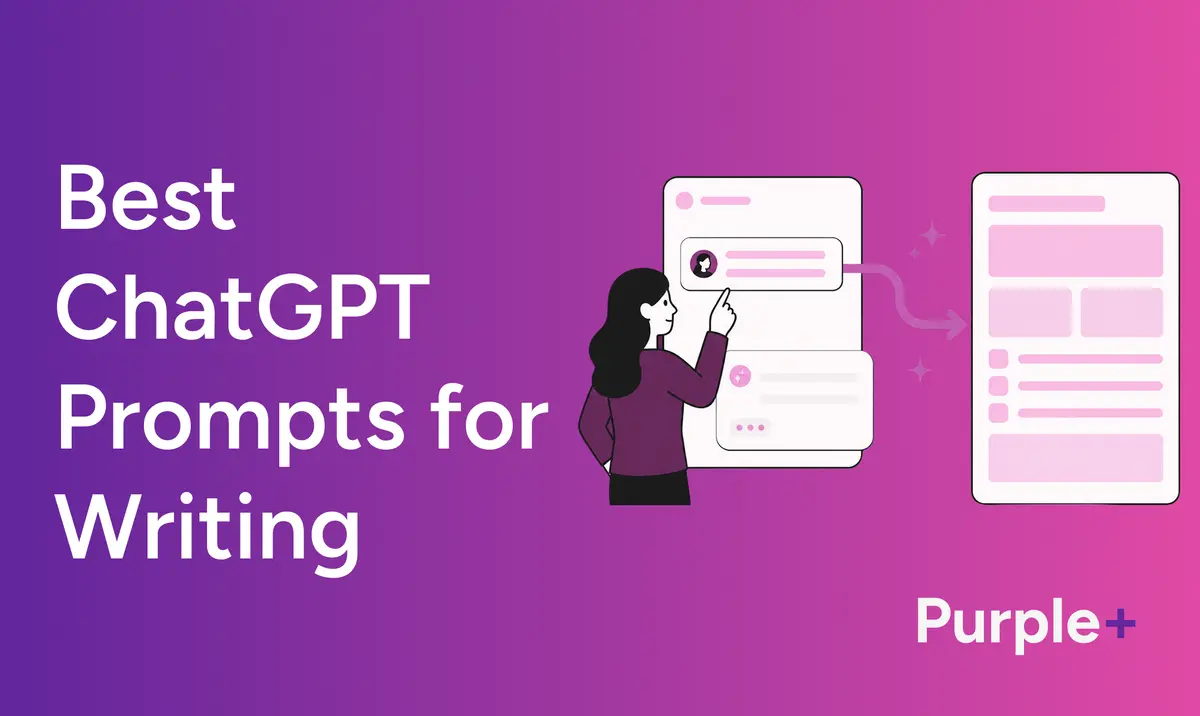
Best ChatGPT Prompts for Writing
ChatGPT can support almost every stage of the writing process, but the prompt needs to reflect the task. Generating a first draft, improving existing content, creating headlines, shortening copy, and restructuring an article all require different instructions.
The following ChatGPT prompts for writing cover common content and marketing tasks, from blog articles and website copy to social media posts and emails. You can adapt them to your audience, brand voice, content goals, and preferred format.
When you work with a high volume of content, however, keeping track of different prompts and repeating the same instructions for every task can become time-consuming. Instead of manually remembering which prompt to use for each type of content, Purple+ can help bring these marketing activities into one workflow, making it easier to manage content creation alongside planning, scheduling, and other marketing tasks.
ChatGPT Prompts for Different Writing Tasks
Different writing tasks require different instructions. A prompt designed to create a blog post, for example, needs information about the topic, audience, search intent, and structure, while an editing prompt should focus on improving an existing piece without changing its meaning.
The prompts below cover some of the most common writing tasks and can be customised with your own requirements.
Prompt for Writing a Blog Post
Act as an experienced content writer. Write a [word count]-word article about [topic] for [target audience].
The main goal is to [goal]. Use “[primary keyword]” naturally and include relevant secondary keywords where appropriate.
Structure the article with a clear H1, H2 and H3 hierarchy. Keep paragraphs concise, provide practical information, and avoid repetition, filler, and generic statements.
Use a [tone] tone. Include relevant examples where they help explain the topic and finish with a concise conclusion and FAQs.
This is one of the best ChatGPT prompts for writing when you want a structured first draft rather than a generic article.
For SEO-focused content, you can make the prompt more specific by adding search intent, related queries, internal linking requirements, and content gaps identified from competing pages. AI SEO content workflow can help connect content creation with the wider publishing process.
Prompt for Improving Existing Content
Act as a professional editor. Review the content below and improve its clarity, structure, readability, and usefulness without changing its core meaning.
Remove repetition and unnecessary wording. Strengthen weak sections, improve transitions, and make the language sound natural.
Preserve important facts, terminology, and the intended audience.
[Paste content]
This approach is often more useful than asking ChatGPT to rewrite an entire piece from scratch. You retain control over the original information while using AI to identify areas that need improvement.
Prompt for Writing an Introduction
Write three introduction options for an article about [topic]. The introduction should immediately explain the topic and why it matters to [audience].
Keep each option concise and informative. Avoid generic statements, clichés, rhetorical questions, and unnecessary background information.
A useful introduction should establish the subject quickly. For search-focused content, it should also make it clear that the article addresses the query behind the target keyword.
Prompt for Creating Headlines
Generate 15 headline options for an article targeting the keyword “[keyword]”.
Each headline should clearly communicate the article's value and match the search intent behind the keyword.
Keep the wording natural and specific. Avoid clickbait, unnecessary adjectives, and repetitive headline structures.
You can then ask ChatGPT to evaluate the options based on search intent, clarity, relevance, and likely click appeal instead of simply choosing the first suggestion.
Prompt for Rewriting Content
Rewrite the following text for [audience].
Keep the original meaning and important information, but make the wording clearer, more concise, and more natural.
Maintain a [professional/friendly/technical] tone. Remove unnecessary repetition and avoid adding claims that are not supported by the original text.
[Paste content]
This prompt is particularly useful when adapting existing material for a different audience or channel.
Prompt for Making Content More Concise
Reduce the following text by approximately 30% without removing important information.
Keep the main argument, key facts, and essential examples. Remove repetition, filler, and unnecessary phrases while keeping the writing natural.
Do not introduce new information.
[Paste content]
The instruction not to introduce new information is important when editing factual or business content.
Prompt for Creating a Content Brief
Act as an SEO content strategist. Create a content brief for an article targeting “[primary keyword]”.
Include:
-
Search intent
-
Target audience
-
Recommended content angle
-
Primary and secondary keywords
-
Related topics
-
H2 and H3 structure
-
Questions the article should answer
-
Internal linking opportunities
-
Suggested FAQs
Keep each section focused on a distinct search need. Avoid overlapping the article with closely related pages targeting different keywords.
A strong content brief gives the writer a clearer framework before drafting begins. It can also become the starting point for an SEO content marketing workflow, where content planning, creation, optimisation, and publication are treated as connected activities.
Best ChatGPT Prompts for Social Media
Social media prompts need more context than a simple request to “write a post”. The platform, audience, content format, campaign goal, brand voice, and desired action can all change the final result.
A useful prompt should therefore tell ChatGPT what the post needs to achieve, rather than focusing only on the topic.
Prompt for Creating a Social Media Post
Act as a social media content strategist. Write a [platform] post about [topic] for [target audience].
Goal: [awareness/engagement/traffic/leads/sales].
Key information to include: [information].
Brand voice: [tone].
Include a clear but natural call to action. Keep the post appropriate for the platform and avoid generic marketing language.
The same prompt can produce very different results depending on the information supplied.
A LinkedIn post may need more explanation and professional context, while an Instagram post may rely more heavily on concise messaging and visual context. Giving ChatGPT the platform prevents it from treating every social network as the same publishing environment.
Prompt for Creating Multiple Post Variations
Create five variations of a social media post about [topic].
Keep the core message consistent but give each version a different angle:
-
Educational
-
Problem-focused
-
Data-led
-
Conversational
-
Promotional
Write each version for [platform] and maintain the same brand voice.
This is useful when you need several posts from one idea without publishing essentially identical copy.
Prompt for Creating a Social Media Content Calendar
Create a 30-day social media content plan for [business].
Target audience: [audience].
Main goals: [goals].
Platforms: [platforms].
Posting frequency: [frequency].
Include a mixture of educational, promotional, engagement, customer-focused, industry, and brand content.
For each post, provide the date, topic, content angle, format, suggested caption direction, and CTA.
You can then review the output and organise it into a publishing workflow. A content calendar is particularly useful when individual ChatGPT ideas need to become a coordinated schedule across blogs, social posts, campaigns, and other marketing activities.
Prompt for Adapting Content for Different Platforms
Take the following core message and create platform-specific versions for LinkedIn, Instagram, Facebook, and X.
Keep the central message and factual information consistent, but adapt the structure, length, tone, and CTA for each platform.
Do not copy the same wording across all versions.
[Paste content]
This helps solve a common problem with AI-generated social content: producing several technically different posts that still sound almost identical.
Prompt for Repurposing a Blog Into Social Content
Analyse the following blog article and identify 10 distinct ideas that could become social media posts.
For each idea, provide:
-
Main takeaway
-
Recommended platform
-
Suggested content angle
-
Short post concept
-
CTA
Do not repeat the same point in different wording.
[Paste article]
This turns one long-form asset into multiple social content ideas while keeping the posts connected to the original subject.
Prompt for Creating Engagement Posts
Create 10 social media posts designed to encourage meaningful engagement around [topic].
Use a mixture of questions, opinions, practical scenarios, and discussion prompts.
Avoid engagement bait and questions that can be answered with only “yes” or “no”.
Write for [audience] in a [tone] tone.
The goal is to give people a genuine reason to respond rather than simply asking them to “comment below”.
ChatGPT Prompts for Content Planning
ChatGPT can also be useful before you start writing. Instead of asking it only to produce finished copy, you can use prompts to explore topics, organise ideas, identify content relationships, and build a publishing plan.
Prompt for Finding Content Ideas
Generate 30 content ideas for [business/topic] targeting [audience].
Group the ideas by search intent: informational, commercial, transactional, and navigational.
Identify the primary topic for each idea and avoid near-duplicates or variations that would compete for the same search intent.
Prompt for Building a Content Calendar
Build a three-month content calendar for [business].
Include blog content, social media content, email content, and campaign-related content.
Organise the plan around [products/services/themes].
Identify how individual pieces of content can support the same campaign or marketing objective.
Include suggested publication dates, content types, target audience, and primary goal.
The important difference is that a content calendar should show relationships between content, rather than simply provide a list of publication dates.
Prompt for Creating a Content Cluster
Create a topical content cluster around “[main topic]”.
Identify:
-
One primary pillar topic
-
Supporting topics
-
Long-tail queries
-
Commercial pages that should be linked from the content
-
Recommended internal links between related articles
Explain each page's role, and avoid creating multiple pages that target the same search intent.
This can help turn individual ChatGPT content ideas into a structured SEO architecture instead of a collection of disconnected articles.
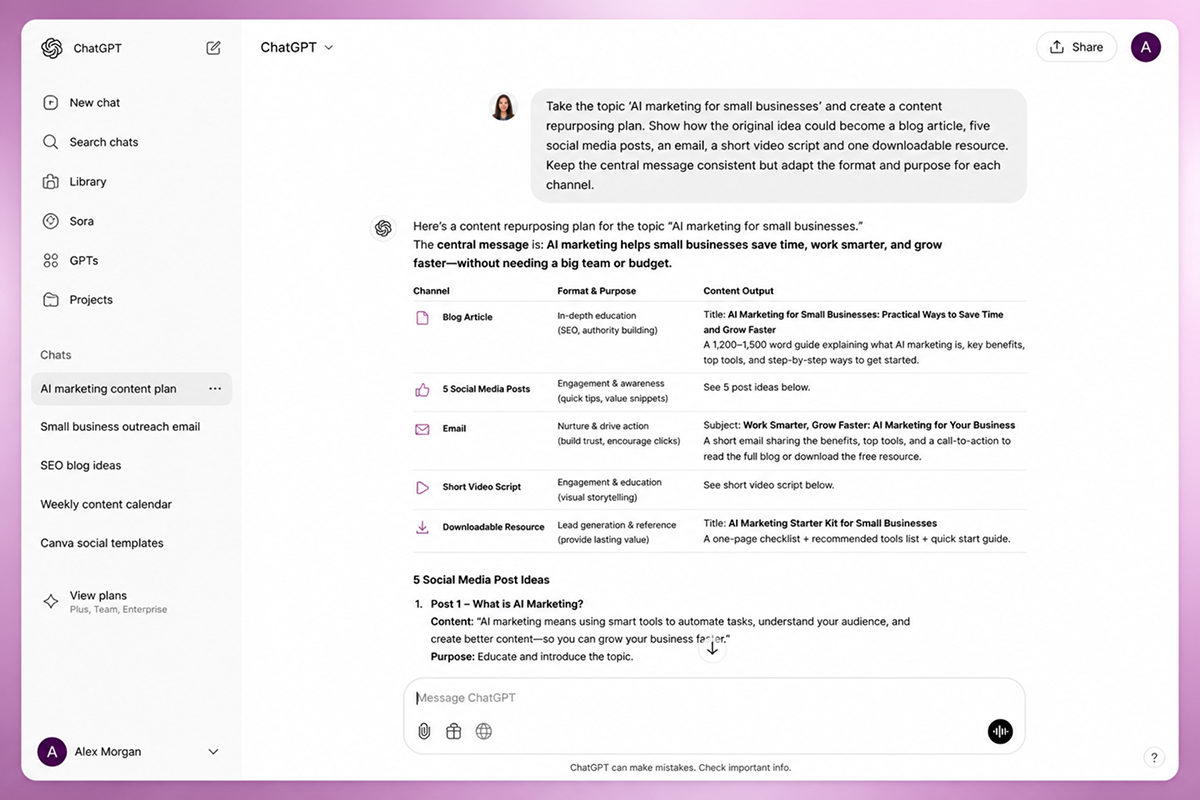
Prompt for Turning One Topic Into Multiple Content Pieces
Take the topic “[topic]” and create a content repurposing plan.
Show how the original idea could become:
-
A blog article
-
Five social media posts
-
An email
-
A short video script
-
Three discussion questions
-
One downloadable resource
Keep the central message consistent but adapt the format and purpose for each channel.
Best ChatGPT Prompts for SEO Content
ChatGPT can support SEO work beyond writing the first draft. With the right instructions, it can help organise keyword research, analyse search intent, create content briefs, improve existing pages, and identify related topics.
The key is to give ChatGPT the SEO information it needs, rather than simply asking it to “optimise this article”. A useful SEO prompt should define the target query, audience, search intent, content objective, and optimisation requirements.
Prompt for Keyword Research
Act as an SEO strategist. Create a keyword research plan for [topic/business].
Primary topic: [topic].
Target audience: [audience].
Location: [country/market].
Identify:
-
Primary keywords
-
Secondary keywords
-
Long-tail keywords
-
Related search queries
-
Questions users may search
-
Commercial keywords
-
Informational keywords
Group the keywords by search intent and identify potential keyword cannibalisation between closely related terms. Do not recommend separate pages when one page can address the same search intent.
This prompt is more useful than asking ChatGPT for a random list of keywords because it asks the model to organise the terms by their role on the site.
Prompt for an SEO Content Brief
Act as an SEO content strategist. Create a content brief targeting “[primary keyword]”.
Analyse the likely search intent and define the target audience and purpose of the page.
Include:
-
Primary keyword
-
Secondary keywords
-
Related entities and concepts
-
Questions users may have
-
Recommended H2 and H3 structure
-
Key information each section should cover
-
Internal linking opportunities
-
FAQ topics
Keep the article focused on one primary search intent. Avoid adding sections that do not help satisfy the query.
A good brief gives a writer or AI tool a clear framework before content production starts.
Prompt for Optimising an Existing Article
Act as an SEO editor. Review the article below against the target keyword “[keyword]”.
Evaluate:
-
Search intent alignment
-
Keyword usage
-
Heading structure
-
Topic coverage
-
Missing subtopics
-
Internal linking opportunities
-
Readability
-
Repetition
-
Potential keyword cannibalisation
Identify specific improvements first. Then provide revised sections only where changes are needed.
Do not add keywords unnaturally or change factual information.
[Paste article]
This two-stage approach is useful because it asks ChatGPT to analyse before rewriting. That can prevent unnecessary changes to content that is already performing well.
Prompt for Writing Meta Titles and Descriptions
Create 10 SEO meta title options and 10 meta description options for a page targeting “[primary keyword]”.
The title should clearly communicate the page topic and match search intent.
The meta description should explain what the user will find on the page and encourage a relevant click without using clickbait.
Keep the wording natural and avoid keyword stuffing.
Then ask ChatGPT to select the strongest option based on relevance, clarity, and search intent.
Prompt for Finding Related Topics
Act as a topical SEO strategist. Build a list of related topics around “[main topic]”.
Group them into:
-
Core concepts
-
Supporting topics
-
Related questions
-
Practical subtopics
-
Commercial topics
-
Comparison topics
Identify which topics belong on the main page and which could become separate supporting pages. Avoid creating separate pages when the search intent substantially overlaps.
This is useful when building a larger topical structure and deciding which ideas should become articles, service pages, or supporting content.
Prompt for Search Intent Alignment
Analyse the search intent behind “[keyword]”.
Explain:
-
What the searcher is likely trying to accomplish
-
What information they expect to find
-
What type of page best satisfies the query
-
What questions the page should answer
-
What content would fail to satisfy the intent
Then create a recommended page structure based on this intent.
This helps prevent a common SEO problem: creating content around a keyword without actually addressing what people searching for that term want.
Best ChatGPT Prompts for Email Marketing
ChatGPT can help with individual emails and larger email campaigns. The prompt should identify the recipient, purpose, offer, tone, and desired action.
Prompt for Writing a Marketing Email
Act as an email marketing specialist. Write an email for [audience] promoting [product/service/offer].
Goal: [goal].
Main benefit: [benefit].
Key information: [information].
CTA: [action].
Use a [tone] tone. Keep the email concise and make the main value clear early in the message.
Avoid exaggerated claims, unnecessary urgency, and generic marketing phrases.
For businesses managing several campaigns, the generated copy can become part of a marketing automation workflow, where emails connect to customer actions and campaign stages.
Prompt for a Welcome Email
Write a welcome email for a new [customer/subscriber/user].
Explain what they can expect, introduce [business/product], highlight the most important next step, and include one clear CTA.
Keep the email friendly, concise, and useful. Do not overload the reader with information.
Prompt for Email Subject Lines
Generate 20 subject lines for an email about [topic].
Create a mixture of:
-
Benefit-led
-
Curiosity-based
-
Direct
-
Educational
-
Problem-focused
Keep them concise and relevant to the email content. Avoid clickbait and misleading claims.
Prompt for an Email Campaign
Create a five-email campaign for [product/service/goal].
Define the purpose of each email and include:
-
Subject line
-
Main message
-
Key information
-
CTA
-
Recommended timing
Each email should move the reader to the next stage of the campaign without repeating the previous message.
Best ChatGPT Prompts for Marketing Campaigns
ChatGPT can generate different versions of advertising copy based on the campaign objective, target audience, offer, and desired action. For search campaigns, you can make the prompt more specific by providing the target keywords, search intent, key benefits, and character limits.
This gives ChatGPT enough context to create ad copy that is relevant to the campaign rather than generic promotional text.
These same principles apply when learning how to use ChatGPT for Google Ads, particularly when creating and refining search ad copy around specific keywords and user intent.
Prompt for Campaign Strategy
Act as a marketing strategist. Create a campaign plan for [product/service].
Campaign goal: [goal].
Target audience: [audience].
Campaign duration: [duration].
Budget: [budget].
Main offer: [offer].
Define the campaign message, audience segments, content requirements, channels, CTAs, and measurement criteria.
Organise the plan by campaign stage and explain the purpose of each activity.
Prompt for Defining the Target Audience
Analyse the target audience for [product/service].
Identify:
-
Primary audience
-
Secondary audience
-
Main problems
-
Motivations
-
Objections
-
Buying triggers
-
Information they need before making a decision
-
Preferred content formats
Separate assumptions from information provided in the brief.
Prompt for Creating Ad Copy
Act as a paid advertising copywriter. Create 10 ad variations for [product/service].
Audience: [audience].
Platform: [Google/Meta/LinkedIn].
Objective: [objective].
Main benefit: [benefit].
CTA: [CTA].
Give each variation a different angle while keeping the claims accurate and consistent with the supplied information.
For larger campaigns, ChatGPT-generated copy can sit alongside paid advertising workflows rather than being treated as a separate writing exercise.
How to Write a Prompt for ChatGPT That Gets Better Results
The best way to prompt ChatGPT is not necessarily to create one extremely long instruction. A better approach is to provide the information that affects the result and refine the response as needed.
A practical workflow looks like this:
Initial prompt → Review response → Identify weaknesses → Add context → Refine instructions → Generate again
Start With the Result You Need
Before writing the prompt, define the outcome.
Instead of:
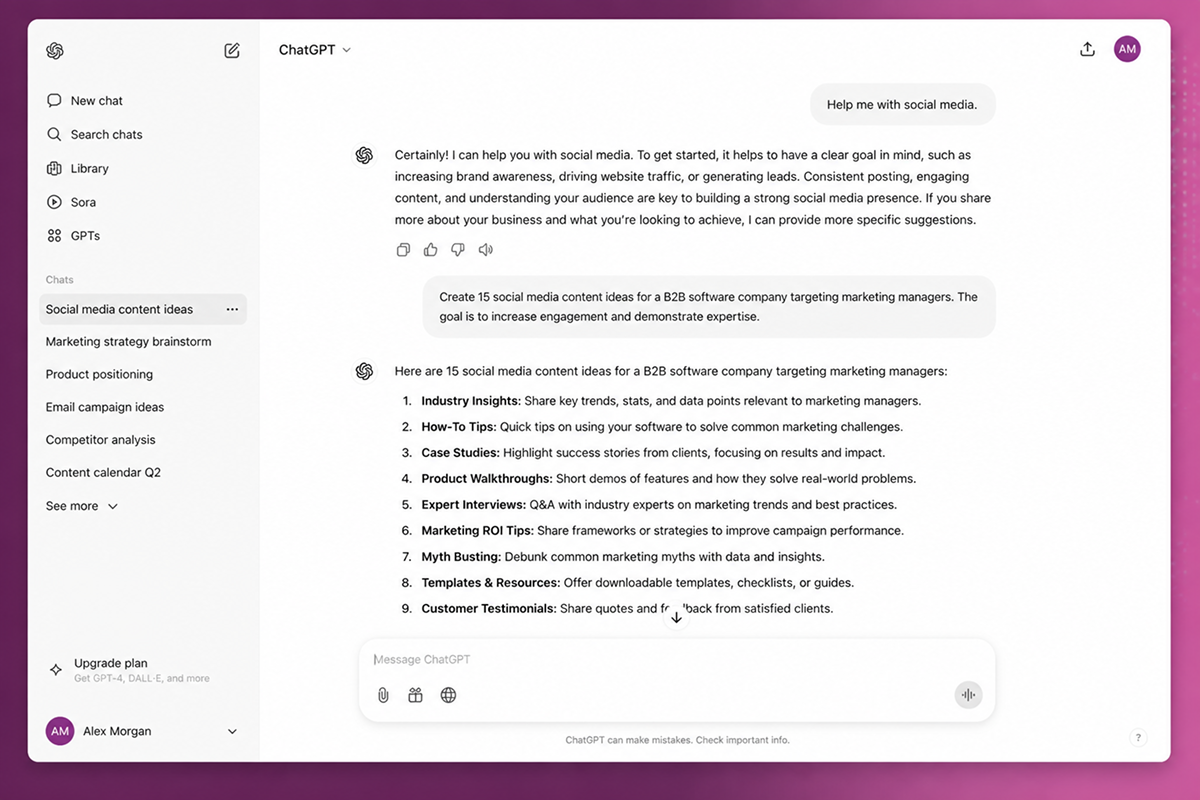
Help me with social media.
Try:
Create 15 social media content ideas for a B2B software company targeting marketing managers. The goal is to increase engagement and demonstrate expertise.
The second version gives ChatGPT a measurable direction.
Give ChatGPT the Information It Cannot Guess
If the content needs to represent a specific company, provide the relevant facts.
For example:
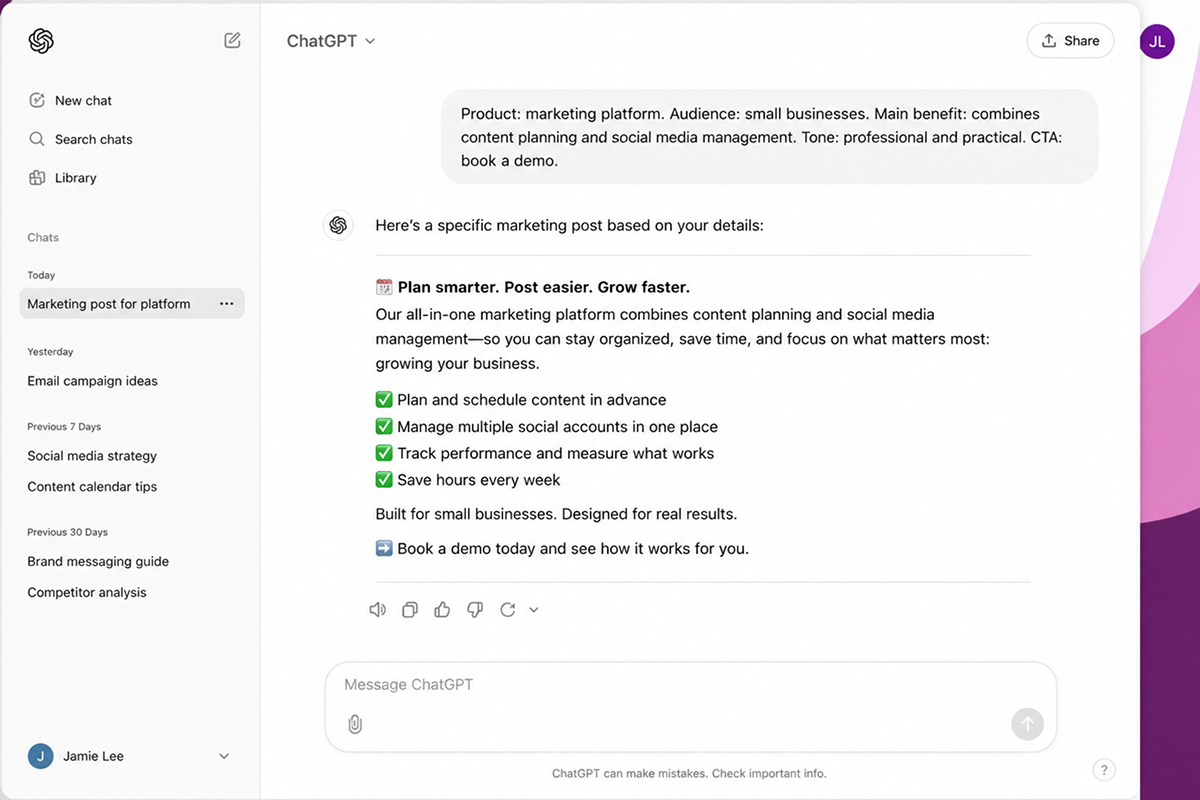
Product: marketing platform
Audience: small businesses
Main benefit: combines content planning and social media management
Tone: professional and practical
CTA: book a demo
This reduces generic output and gives ChatGPT material to work with.
Ask for a Specific Format
If you need a table, ask for a table. If you need five variations, specify five. If you need H2/H3 headings, say so.
For example:
Return the results in a table with these columns: Topic, Search Intent, Primary Keyword, Secondary Keywords, Suggested H2, Internal Link Opportunity.
Clear formatting instructions make the output easier to review and use.
Review and Refine the First Response
The first response does not have to be the final one.
You can follow it with instructions such as:
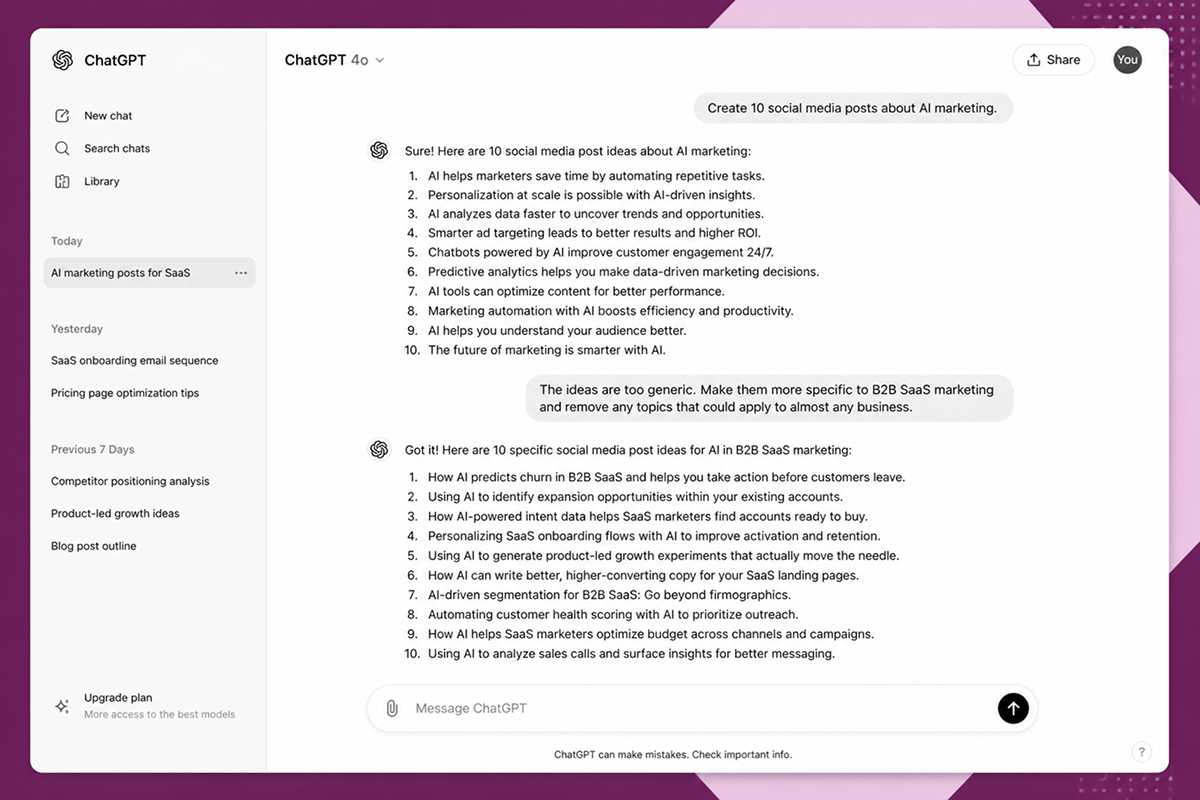
The ideas are too generic. Make them more specific to B2B SaaS marketing and remove any topics that could apply to almost any business.
Or:
Keep the structure but make the language more concise and remove repetitive sections.
This iterative process is often more effective than trying to create the perfect prompt immediately.
ChatGPT Prompt Generator: How to Create Your Own Prompts
If you frequently use ChatGPT for different tasks, creating a reusable ChatGPT prompt generator template can save time.
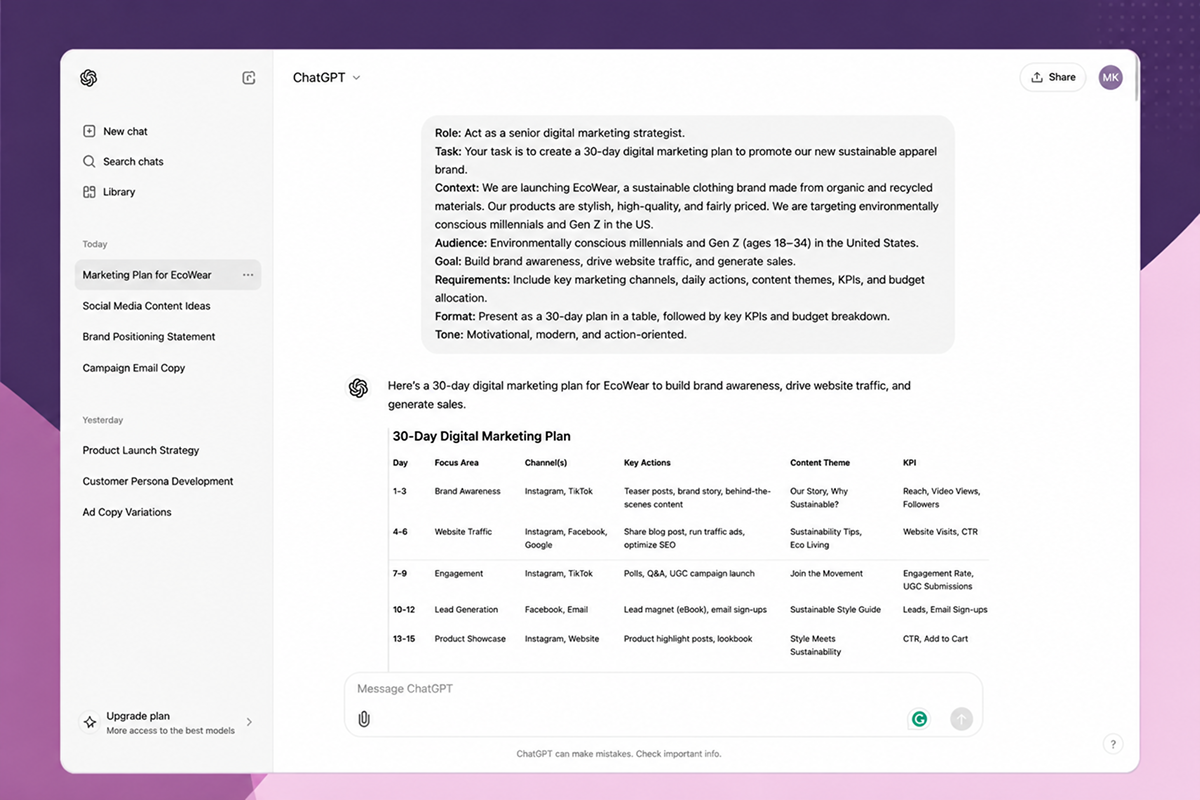
Use this structure:
Role: Act as [specialist].
Task: Your task is to [specific task].
Context: [business/topic/background information].
Audience: [target audience].
Goal: [desired outcome].
Requirements: [specific requirements].
Format: [desired format].
Tone: [tone of voice].
Avoid: [specific things to avoid].
Quality check: Before providing the final answer, check that you followed all requirements.
You can reuse the same framework for SEO research, blog writing, social media content, email campaigns, and marketing planning.
The important part is replacing the placeholders with specific information relevant to the task. A reusable template is useful, but the quality still depends on the instructions and context you provide.
Common ChatGPT Prompt Mistakes
Even a technically detailed prompt can produce poor results if the instructions are unclear.
Too Little Context
A request such as “write a post about our service” leaves too many important decisions to the model.
Give ChatGPT information about the service, audience, purpose, key benefits, and platform.
Asking for Too Many Tasks at Once
A single prompt asking ChatGPT to research keywords, analyse competitors, create a content strategy, write ten articles, and produce social posts can result in shallow output.
Break complex workflows into stages when each stage requires meaningful analysis.
Using Vague Instructions
Words such as “good”, “professional”, “interesting”, and “SEO-friendly” can mean different things.
Explain what you mean:
Keep paragraphs under four sentences, use descriptive headings, answer the main search query early, and avoid repetitive wording.
Specific instructions are easier for ChatGPT to follow.
Not Defining the Audience
Content for a beginner, experienced marketer, business owner, and technical specialist should not sound the same.
Always provide the intended audience when it affects the response's depth or tone.
Not Specifying the Output
If you need a content brief, ask for a content brief. If you need a table, specify the columns. If you need five options, specify five.
The desired output format is part of the prompt.
Accepting the First Response
ChatGPT's first answer is a starting point, not a guarantee of quality.
Review it for accuracy, relevance, tone, repetition, and missing information. Then refine the prompt based on what needs improvement.
How Businesses Can Use ChatGPT Prompts in Their Marketing Workflow
ChatGPT becomes more useful when individual prompts are connected to a wider marketing process.
A marketer might use one prompt to generate content ideas, another to create a brief, another to write the article, and another to turn the finished article into social media posts.
The workflow could look like:
Research → Planning → Content creation → Editing → SEO optimisation → Social content → Scheduling → Publishing → Analysis
The advantage comes from connecting these activities instead of treating every ChatGPT request as an isolated task.
For example, a blog topic can become an SEO article, several social media posts, an email, and additional campaign content. A structured workflow can then organise those assets for publication and future reuse.
This is where AI-assisted content creation can connect with broader marketing software. Instead of moving manually between separate tools for every stage, businesses can bring content planning, creation, scheduling, and marketing activities into a more connected workflow.
Best ChatGPT Prompts: Quick Reference
|
Task |
Prompt focus |
|
Blog writing |
Topic + audience + goal + structure |
|
Content editing |
Clarity + readability + accuracy |
|
Headlines |
Keyword + intent + angle |
|
Social posts |
Platform + audience + objective |
|
Content calendar |
Topics + formats + frequency |
|
Keyword research |
Search intent + keyword groups |
|
SEO brief |
Keywords + structure + content requirements |
|
Meta descriptions |
Keyword + page purpose + value |
|
Email marketing |
Audience + offer + CTA |
|
Campaign planning |
Audience + goal + channels + measurement |
The strongest ChatGPT prompts are rarely the longest ones. They give the model the information it needs to make the right decisions.
A clear task, useful context, defined audience, specific requirements, and a precise output format can make a major difference to the quality of the response.
From there, reviewing and refining the prompt allows ChatGPT to become part of a repeatable writing and marketing workflow rather than a tool used only for one-off content generation.
Frequently asked questions
Written by
AI & SEO Content writer
Tetiana Reusche is an SEO Content Strategist and AI marketing specialist who specialises in creating content that helps businesses improve their online visibility and turn organic traffic into business growth. Her work combines search strategy, content marketing, and AI-driven optimisation to produce content that performs across search engines, answer engines, and modern AI-powered discovery platforms. Over the years, she has developed SEO strategies and content frameworks for companies in the SaaS, software, miltech, travel, real estate, home renovation, lifestyle, and entertainment industries. She enjoys translating complex topics into practical, engaging content that is valuable for both readers and search engines. Tetiana focuses on building topical authority through strategic keyword research, content planning, search intent analysis, and well-structured content ecosystems. She regularly creates keyword clusters, content recommendations, editorial roadmaps, and SEO strategies that help brands reach the right audience, strengthen their authority, and generate meaningful business results. Her articles explore SEO, AI-powered marketing, social media management, content strategy, and digital growth, with a practical focus on helping businesses create discoverable, useful content designed to convert.