
AI Content Creation vs AI Content Automation: Key Differences

AI content creation uses artificial intelligence to generate or improve content, such as blog articles, social media posts, email copy and advertisements. AI content automation connects content-related tasks into a workflow, helping businesses manage production, review, scheduling, publishing and performance tracking.
The difference lies in what happens after the initial draft. AI content creation produces the asset; AI content automation helps move that asset through the content lifecycle. Businesses can use either capability independently or combine them to manage content from brief to publication.
For example, an AI writing tool can generate social media captions for a product launch. A content automation workflow can organise those captions, send them for approval, schedule the selected versions and track publication status through connected tools.
|
Area |
AI content creation |
AI content automation |
|
Main function |
Generate, rewrite or adapt content |
Coordinate and automate content-related tasks |
|
Typical outputs |
Articles, captions, emails, product descriptions and ad copy |
Scheduled content, approval workflows, distribution and reporting processes |
|
Main inputs |
Prompts, briefs, source material and brand guidelines |
Content assets, workflow rules, schedules, permissions and connected tools |
|
Human involvement |
Review and refine generated content |
Set rules, approve important decisions and oversee execution |
|
Primary benefit |
Faster content production |
More efficient, consistent content operations |
|
Common use case |
Drafting an SEO article |
Moving an article through review and publication |
The capabilities can overlap. Some AI content creation tools include scheduling or publishing integrations, while content automation platforms use AI to generate and adapt assets within a wider workflow. The key distinction is the range of tasks the software can complete, not the label.
What Is AI Content Creation?
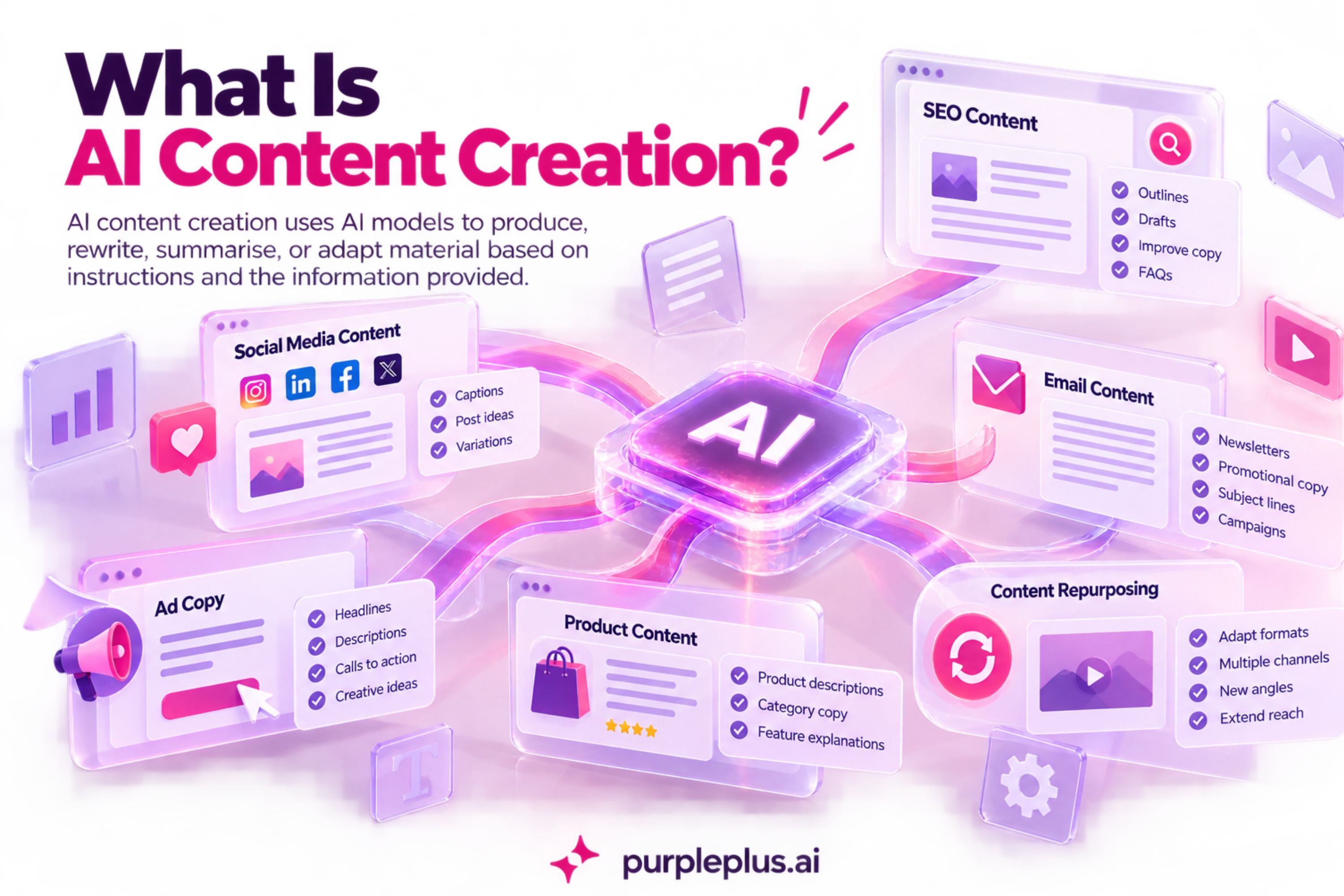
AI content creation uses AI models to produce, rewrite, summarise, or adapt material based on instructions and the information provided. Marketing teams use AI writing tools to speed up production, develop alternative messages, and adapt content for different audiences.
Common applications include:
-
AI SEO content creation: Developing article outlines, drafting sections, improving existing copy and preparing relevant FAQs.
-
Social media content generation: Creating captions, post ideas and platform-specific variations.
-
Email content: Drafting newsletters, promotional messages, subject lines and campaign copy.
-
AI ad copy generation: Producing headlines, descriptions, calls to action and creative concepts.
-
Product content: Writing product descriptions, category copy and feature explanations.
-
Content repurposing: Adapting a webinar, report or article into several formats.
AI content generation is particularly useful when a team needs a first draft, several creative alternatives or variations of an existing message. Instead of starting from scratch for every asset, marketers can work from a shared brief and refine the results.
However, generating more content does not automatically improve content quality. Output depends on the accuracy of the source information, the specificity of the instructions, and the editorial process. Teams still need to verify claims, check brand voice and ensure that each asset serves its intended purpose.
For SEO, that also means assessing search intent, topical coverage and the usefulness of the information. AI can help with drafting and optimisation, but keyword inclusion alone doesn't make a page valuable.
What Is AI Content Automation?
AI content automation links content production to the operational tasks needed to manage and distribute it. It combines AI capabilities with workflow rules and integrations, helping businesses coordinate activities that would otherwise require repeated manual input.
A content automation workflow may include:
-
Content planning: Organising topics, briefs, deadlines and publishing schedules.
-
Production workflows: Moving AI-generated or manually created assets into the review process.
-
Approval management: Assigning reviewers, tracking decisions and identifying outstanding tasks.
-
Content scheduling: Preparing approved assets for publication at planned times.
-
Automated content distribution: Publishing or sending content through supported platforms and integrations.
-
Performance reporting: Collecting available metrics and connecting results with campaign activity.
These functions help teams manage content consistently as publishing demands increase. Instead of tracking every draft through separate messages, files and spreadsheets, they can use defined workflows to keep responsibilities and progress visible.
Automation does not mean every task must run without human input. A business can automate scheduling and status updates while retaining editorial approval before publication. AI can generate a draft, workflow rules can route it to the right person, and a connected publishing tool can distribute the approved version.
Purple+ brings AI-assisted content creation together with planning, publishing and workflow capabilities through its marketing automation software. The relevant features depend on the connected channels, permissions, and actions the platform supports.
AI Content Creation vs AI Content Automation: How They Work Together
Content creation and automation solve different problems, but combining them can make the full content process more efficient.
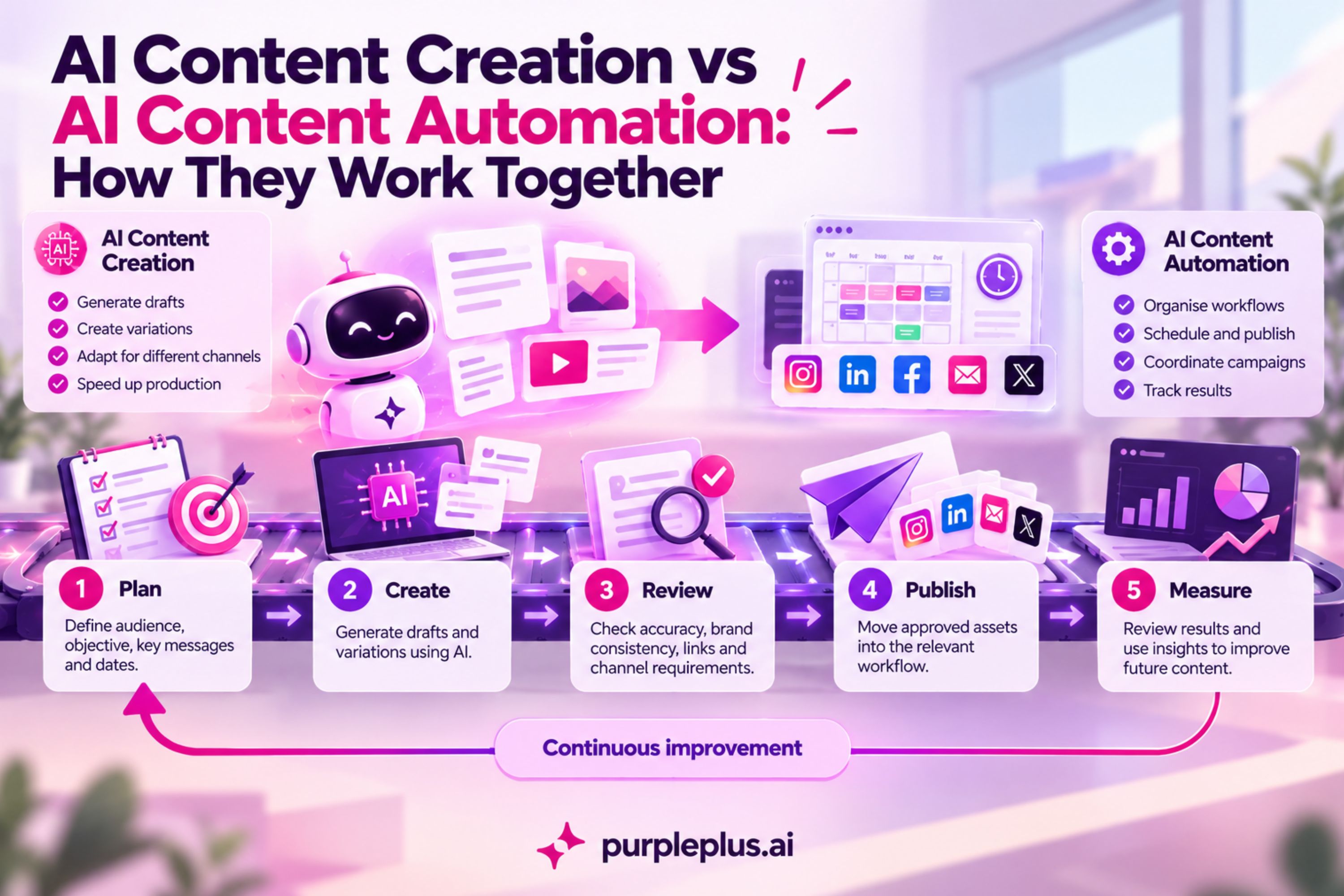
Consider an online store preparing a seasonal promotion. The marketing team needs product descriptions, email copy and social media posts. AI can help create the first drafts from verified product details and the campaign brief. A content workflow can then organise review, schedule approved posts and coordinate the email campaign through connected tools.
The process can follow five stages:
-
Plan: Define the audience, campaign objective, key messages and publication dates.
-
Create: Generate drafts and variations using AI.
-
Review: Check accuracy, brand consistency, links and channel requirements.
-
Publish: Move approved assets into the relevant publishing or email workflow.
-
Measure: Review available results and use the findings to improve future content.
For businesses with growing product catalogues and frequent promotions, an ecommerce marketing platform can connect content creation with campaign planning, email communication and marketing workflows.
The same principle applies to other industries, although the content and approval requirements differ. Restaurants may need regular menu updates and event promotions, while estate agencies must keep property descriptions and listing details accurate as prices and availability change. In both cases, automation can coordinate recurring work, while AI helps produce the content required for each update.
AI Content Creation vs AI Content Automation: Business Applications
The right combination depends on the content a business produces and the work required to publish it.
Social Media Marketing
AI content creation helps marketers develop captions, campaign ideas and variations for different social platforms. Content automation supports the next steps: organising posts, managing approvals, scheduling publication and tracking which assets have gone live.
This distinction matters when a business publishes across multiple accounts. Generating a week's worth of captions saves writing time, but a connected workflow also reduces the effort required to prepare and publish them.
SEO and Content Marketing
AI can help create article outlines, draft sections, update existing pages and repurpose published content. Content marketing automation connects these activities with editorial review, deadlines, publishing and performance reporting.
For a small business, this can make a regular publishing schedule easier to maintain. Purple+'s marketing software for small businesses brings AI content creation, social media, email, automation and connected analytics into one workspace.
Automation still needs editorial controls. Articles should reflect the business's expertise, answer the intended search query and contain accurate information before publication.
Email Marketing
AI can draft newsletters, promotional emails and alternative subject lines. Automation can coordinate the process around those assets, from approval and scheduling to sending through a connected email platform.
The distinction matters because generating an email isn't the same as sending it to the right audience. Email delivery also depends on the connected system, list management, consent and campaign settings.
Advertising and Campaign Content
AI content generation can produce ad headlines, descriptions, creative concepts and variations for testing. Automated workflows can help organise campaign assets and connect them with supported advertising tools.
The exact actions depend on the platform and its integrations. Creating ad copy does not automatically launch a campaign or change its budget. Those actions require the relevant account access, permissions and supported functionality.
Industry-Specific Content Workflows
The content lifecycle also varies by business model. A restaurant may create weekly menu announcements, seasonal promotions and event emails. A connected restaurant marketing platform can help coordinate those assets with campaigns and customer communication.
Real estate teams face another challenge: property details can change frequently, and outdated descriptions or prices can mislead potential buyers. AI can help draft listing content, while an organised workflow ensures updated information gets the necessary checks before publication. This is one use case for real estate marketing software.
In each case, AI content creation supports production, while automation helps coordinate the process around the content.
Benefits of AI Content Creation and AI Content Automation
Both approaches can improve marketing operations, but you should assess their benefits separately.
Benefits of AI Content Creation
AI content creation helps businesses:
-
Produce first drafts faster.
-
Generate alternative messages for different audiences.
-
Adapt existing content for additional channels.
-
Repurpose research and source material.
-
Reduce repetitive writing and editing tasks.
The main gain is production capacity. Teams can spend less time drafting routine assets and more time on research, strategy, creative decisions and quality control.
Benefits of AI Content Automation
AI content automation helps businesses:
-
Reduce manual transfers between tools.
-
Keep approval stages and responsibilities visible.
-
Maintain consistent publishing schedules.
-
Coordinate content across connected channels.
-
Track workflow status and identify delays.
-
Connect publishing activity with available performance data.
-
Manage higher content volumes without adding the same amount of administrative work.
Automation also makes repeatable processes easier to maintain. Once a workflow has clear rules, the team can reuse it for recurring campaigns rather than rebuild the process each time.
The strongest results come from automating tasks that are frequent, predictable and clearly defined. Human judgement remains essential for strategy, factual checks, sensitive communications and decisions that affect customers or advertising spend.
How to Choose Between AI Content Creation and AI Content Automation
Start with the part of the process that creates the biggest bottleneck.
Choose AI content creation when writing, rewriting or adapting assets takes too much time. Look for tools that support your content formats, use the information you provide effectively and produce drafts that require a manageable amount of editing.
Choose AI content automation when content already exists but takes too long to review, coordinate, publish or measure. Prioritise the workflows and integrations that match your current process.
Combine both when your team needs to increase content production and improve execution. A connected setup can generate assets, route them for review and move approved content into publishing workflows without requiring manual coordination at every stage.
Before selecting a platform, check:
-
Which content formats and channels it supports.
-
Whether it can perform the required actions, rather than only suggest them.
-
Which integrations and permissions are necessary.
-
How approval and review controls work.
-
Whether reporting covers the metrics you need.
-
How subscription, setup and maintenance costs compare with the time saved.
The best choice is the one that improves a real process. A long list of AI features is less useful than a reliable workflow that reduces production delays or removes recurring manual work.
How to Measure the Results
Measure content creation and content automation using different operational metrics, then connect those results to business performance.
|
Metric |
What it measures |
|
Time to produce a usable draft |
Efficiency of AI content creation |
|
Editing and correction time |
How closely generated content meets quality requirements |
|
Content output |
Number of usable assets produced in a given period |
|
Time from draft to publication |
Efficiency of the content workflow |
|
Manual steps per asset |
Amount of work automation removes |
|
Approval delays |
How quickly content moves through review |
|
Publishing errors |
Reliability of the distribution process |
|
Leads, conversions or revenue |
Contribution to business objectives |
Establish a baseline before introducing a new tool. Record the time and cost required to complete a task, then compare the results after implementation. Include editing, approval, setup and maintenance rather than measuring only the time required to generate a draft.
Business outcomes need separate attention. Producing more content or publishing more frequently does not guarantee higher engagement, better rankings or increased sales. Track metrics that match each campaign's objective to see whether operational improvements drive meaningful results.
How AI Content Automation Improves Marketing Efficiency
AI content automation helps marketing teams make content production more organised and repeatable. By connecting content creation with review, scheduling, publishing, and reporting, businesses can reduce manual work, maintain consistent publishing schedules, and manage multi-channel campaigns more efficiently.
AI content creation speeds up individual asset production. Content automation extends those gains across the wider workflow, helping teams move approved content from draft to publication without coordinating every step manually.
The benefits include:
-
Less time spent on repetitive tasks: Automate routine actions such as approval reminders, content scheduling and workflow updates.
-
More consistent publishing: Use defined workflows to keep content calendars organised and publication deadlines visible.
-
Better team collaboration: Track content ownership, review status and outstanding tasks in a shared process.
-
Easier multi-channel distribution: Coordinate approved content across supported social media, email and other marketing tools.
-
Improved workflow visibility: Identify delays, missed steps and opportunities to improve the content process.
-
Greater capacity to scale: Manage more content and campaigns without increasing administrative work at the same rate.
-
More informed optimisation: Connect available performance data with publishing activity to help refine future campaigns.
These advantages make AI content automation particularly valuable for businesses that publish frequently, manage several channels or coordinate work across multiple team members. Instead of treating each asset as a separate task, teams can establish workflows that support the entire content lifecycle.
For example, an ecommerce marketing team can use AI to prepare product campaign content, route drafts for review, coordinate approved assets with its publishing schedule and assess campaign results. A connected workflow makes recurring promotions easier to manage while preserving control over product information, messaging and final approval.
Automation works best when the process has clear rules and appropriate human oversight. Teams can automate routine actions while retaining editorial control over accuracy, brand consistency and important marketing decisions.
The practical objective is to combine faster AI content generation with reliable execution. Businesses can start with one repetitive workflow, measure the time and effort it saves, and expand automation as their content operations grow.
Frequently asked questions
Written by
AI & SEO Content writer
Tetiana Reusche is an SEO Content Strategist and AI marketing specialist who specialises in creating content that helps businesses improve their online visibility and turn organic traffic into business growth. Her work combines search strategy, content marketing, and AI-driven optimisation to produce content that performs across search engines, answer engines, and modern AI-powered discovery platforms. Over the years, she has developed SEO strategies and content frameworks for companies in the SaaS, software, miltech, travel, real estate, home renovation, lifestyle, and entertainment industries. She enjoys translating complex topics into practical, engaging content that is valuable for both readers and search engines. Tetiana focuses on building topical authority through strategic keyword research, content planning, search intent analysis, and well-structured content ecosystems. She regularly creates keyword clusters, content recommendations, editorial roadmaps, and SEO strategies that help brands reach the right audience, strengthen their authority, and generate meaningful business results. Her articles explore SEO, AI-powered marketing, social media management, content strategy, and digital growth, with a practical focus on helping businesses create discoverable, useful content designed to convert.