
How to Use AI for Marketing

A café owner asked us last month how she was actually supposed to "use AI for marketing" when she barely had time to reply to her Instagram comments, let alone learn another piece of software. Fair question. She'd read a dozen breathless articles about agents and automation and come away feeling further behind, not less.
So this is the answer we gave her, written from the perspective of an agency that runs marketing every day. How to use AI for marketing isn't really a software question — it's about handing the repetitive, time-eating parts of marketing to a tool so you can get back to running the business.
Short version: used well, AI lets a one- or two-person team produce the volume of marketing that used to need a small department. Used badly, it produces a flood of generic content nobody reads and Google quietly buries. The difference is entirely in how you set it up. Let's get into the how.

What using AI for marketing actually means
Strip away the hype and using AI for marketing comes down to three jobs: generating content (posts, blogs, emails, ads), scheduling and publishing it across your channels, and surfacing what's working so you can do more of it.
That's it. You're not building a robot. You're delegating the first draft and the busywork.
The reason this matters more when you're a small team is simple: a big brand has people to absorb the manual work. You don't. When you're the marketer, the bookkeeper and the person who actually delivers the service, "post consistently on four channels and send a monthly newsletter" is a lovely idea that never happens. AI is what closes the gap between what you know you should be doing and what you have hours to do.
The benefits (and the honest limits)
The measurable benefit of AI in marketing that shows up first isn't revenue — it's reclaimed time. Marketers using AI consistently report getting hours back each week, mostly from drafting and repackaging. That time is the whole game for a small team.
The three real benefits, in order:
-
Speed. The blank page disappears. A week of content goes from a half-day to twenty minutes of editing.
-
Consistency. The reason most small businesses stall isn't bad content, it's sporadic content. AI makes "every week" achievable.
-
Reach without headcount. One person can credibly run social, a blog and an email list — work that used to need three.
And the honest limits, because they matter just as much: AI doesn't know what's true about your business, it doesn't have judgement, and left unattended it produces content that's technically fine and completely forgettable. It's a first draft, not a finished campaign. Keep that framing and everything else falls into place.
Real examples: where AI actually helps
Enough theory — here's what using AI in marketing looks like in practice, across the five channels where it reliably earns its place.
Social media. Turn one idea into a week of posts, adapt the wording per platform, and queue it to publish on a schedule. You approve, it posts. This is the single biggest time-saver for most small teams, and it's the core of what our social media management tools do.
SEO and blog content. A steady stream of helpful posts is how you show up in search without paying for every click. AI drafts the article; you add the first-hand detail only you have. Purple+ drafts AI SEO content and publishes it straight to WordPress or Shopify.
Email. Your list is the one marketing asset you own outright. AI drafts the newsletter, the promo, the follow-up — then Purple+ sends it through your existing email marketing platform (Brevo or Mailchimp), where your lists, segments and sending already live. The AI is the writing layer, not a new inbox to manage.
Paid ad campaigns. You don't need a media agency to run a sensible AI marketing campaign. AI generates the creative and copy for paid advertising, and a good platform surfaces the live results from Meta and Google Ads so you can see what's landing without logging into three dashboards. Start small, watch the numbers, scale what works.
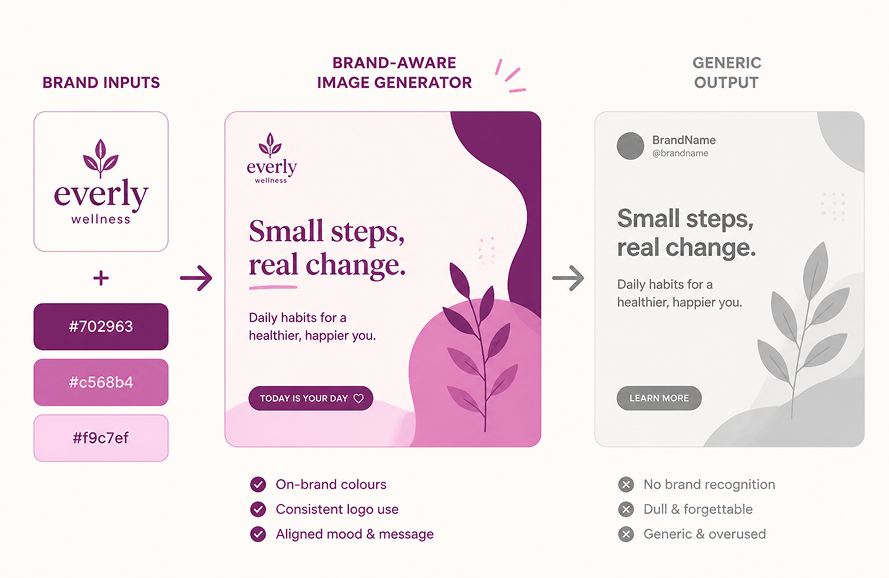
On-brand images. This is where generic tools fall down. ChatGPT and Midjourney are brand-blind — they don't know your colours or your logo. Purple+ generates images using your brand palette and identity, so a post looks like it came from you, not a stock library. With no designer on staff, that's the difference between "looks professional" and "looks like everyone else's AI."
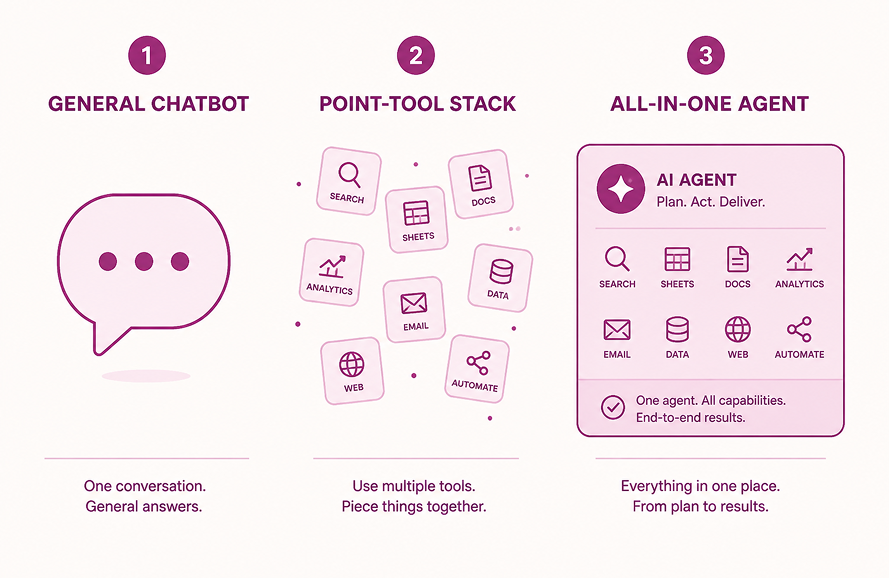
The three ways people use AI for marketing (and which one wins)
Broadly, there are three routes. They're not equally good, and the right one depends on how much time you have to stitch things together.
|
Approach |
What it looks like |
Best for |
The catch |
|---|---|---|---|
|
A general chatbot (ChatGPT, Claude) |
You prompt it for copy, then copy-paste into each platform yourself |
Occasional one-offs, brainstorming |
It writes, but it doesn't schedule, publish, or know your brand. All the manual work stays with you |
|
A stack of point tools |
One tool for social, one for email, one for SEO, one for design |
Teams with time to manage integrations |
You're paying for and learning five tools that don't talk to each other. Costs and tabs stack up fast |
|
One all-in-one AI agent (e.g. Purple+) |
One chat handles social, blog, email, ads and images, then publishes |
Small teams and solo owners who want output, not admin |
You trade a little best-in-class depth for having everything in one place |
Expert insight (from running this daily): the mistake we see most is a small team assembling the point-tool stack because each tool looked great in isolation, then abandoning half of it within two months because nobody has time to be the integration engineer. For a lean team, the tool you'll actually keep using beats the tool with the longest feature list every time. Consolidation isn't a compromise here — it's usually the only version that survives contact with a real week. (If your bottleneck is process rather than content, that's the job of marketing automation, which is a slightly different question.)
A realistic one-hour-a-week workflow
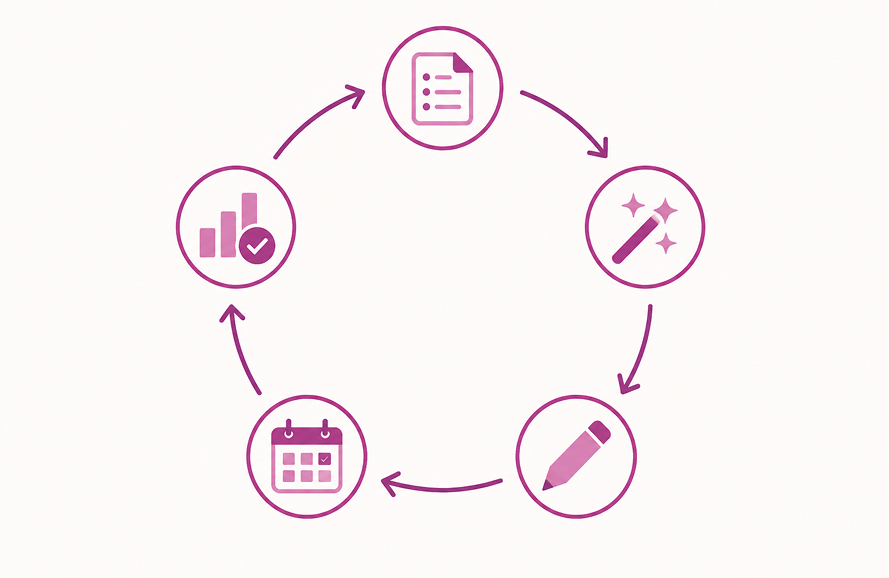
Forget "AI does your marketing while you sleep." Here's what good actually looks like — roughly an hour, once a week.
-
Brief it (10 min). Tell your AI tool what's happening this week: a promotion, a new product, a seasonal angle. One or two sentences is enough.
-
Generate the week (5 min). Have it draft the social posts, one blog post, and the week's email in one go.
-
Edit for truth (20 min). The non-negotiable human step. Add the specific detail only you know — the actual result, the real customer story, the honest caveat. This is what makes it yours and what makes Google trust it.
-
Approve and schedule (10 min). Queue the posts, set the blog to publish, line up the email.
-
Glance at last week's numbers (15 min). See what got engagement, note it, feed it into next week's brief.
That's the whole loop. The AI removes the blank-page problem and the publishing busywork. You keep the two things it can't do: knowing your business, and deciding what's true.
The mistakes that quietly cost you
We've cleaned up after all of these.
Auto-publishing at scale. Some tools will happily push hundreds of AI articles a month straight to your site. Don't. Google's own guidance on helpful, people-first content is explicitly designed to find and demote mass-produced content made for rankings rather than readers. A handful of genuinely useful posts beats a hundred hollow ones.
Brand-blind visuals. If your images don't use your colours or logo, they undercut the professionalism you're trying to project — the one place generic AI tools consistently let small teams down.
Set-and-forget. AI is a first draft, not a final answer. The businesses that get burned are the ones that stopped reading their own output. Keep a human on anything a customer sees.
No approval step. Even a team of one benefits from a "does this actually sound like us?" pause before publishing. If you work with a partner or a VA, a proper approval flow keeps things on-brand without you being the bottleneck.
Ignoring E-E-A-T. Google rewards content that shows real experience and expertise. For a small operator, that's your edge over faceless competitors — you've actually done the thing. Say so, put your name on it, add the detail only a real operator would know. (Google's Search Essentials spell this out.)
How to start this week
You don't need a strategy deck. Pick one channel and go.
Start with whatever's most broken. If you post to social inconsistently, start there. If you've got a list you never email, start there. Get one loop working before you add a second.
If you want to see the landscape first, we keep an honest, tested rundown of the best free AI marketing tools and, if ads are your priority, the best free AI ad generators. If you're a smaller team weighing up a single platform versus a stack, our breakdown of marketing software for small business walks through what to look for.
And if you'd rather just start doing the work, Purple+ is free — genuinely free, not a seven-day countdown. 100 credits a month, no card, set up in about 90 seconds. Draft a week of posts, publish a blog, send an email, all from one chat.
We built Purple+ because we were tired of watching small teams pay for five tools they'd never fully use. If you don't need the paid features, don't pay for them. Get your weekly loop working, and upgrade only when you've outgrown the free tier.
Try Purple+ free at app.purpleplus.ai. No card, no countdown, no surprise invoice next month. See pricing if you want the full breakdown first.
Frequently asked questions
Written by
Founder & Director
Vincent Carrié is the Founder & Director of Purple Media, a full-service digital marketing agency in Gibraltar working with brands including Holland & Barrett, Vitabiotics, and Gibtelecom. Drawing on years of hands-on campaign experience, he's building Purple+ — an AI marketing agent that creates and publishes brand-aligned content across social, paid ads, SEO, and email from a single chat. He writes about applying AI to real marketing workflows, with a focus on what actually drives results for solopreneurs, SMBs, and agencies.