How to Create Better Ads with Ad Creative AI
Creating effective advertisements is no longer limited by the time required to write copy or design creative assets. Ad creative AI enables marketing teams to generate, refine, and test advertising creatives faster by combining artificial intelligence with structured creative workflows.
Instead of producing a single version of an advertisement, marketers can quickly develop multiple creative concepts, adapt messaging for different audiences, and prepare campaign assets for review before launch.
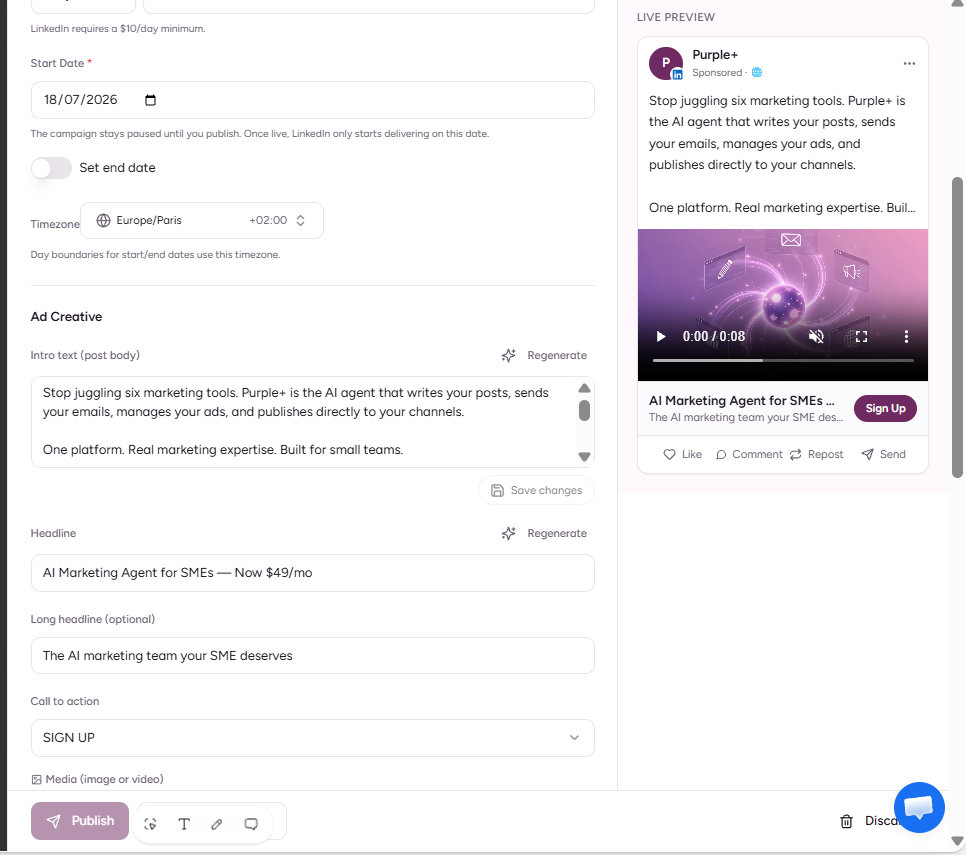
Modern AI is not limited to generating advertising copy. It can assist with headlines, display banners, image concepts, product descriptions, calls to action, responsive search ads, social media ads, and creative variations, making it easier to build campaigns for Google Ads, Meta Ads, LinkedIn Ads, and other digital channels from a single creative brief.
Why Ad Creative Production Has Become More Complex
Creating an advertisement rarely involves a single headline and image. Most campaigns require multiple creative assets for different platforms, audience segments, placements, and campaign objectives.
A single product launch may include responsive search ads for Google, carousel ads for Meta, display banners, short-form social media ads, retargeting creatives, and alternative versions for A/B testing.
As campaign complexity increases, producing every creative manually becomes one of the biggest constraints in digital advertising. Designers prepare visual assets, copywriters write multiple messaging variations, marketing teams review compliance, and campaign managers organize creatives for different channels. Every revision adds another production cycle before the campaign can go live.
AI changes this workflow by accelerating creative production rather than replacing it. Instead of starting every asset from a blank page, marketers can generate multiple advertising concepts, compare different messaging angles, and refine the strongest ideas before publication. This reduces production time while allowing creative teams to focus more on campaign strategy, audience targeting, and creative direction rather than repetitive content creation.
How Ad Creative AI Generates Campaign Assets
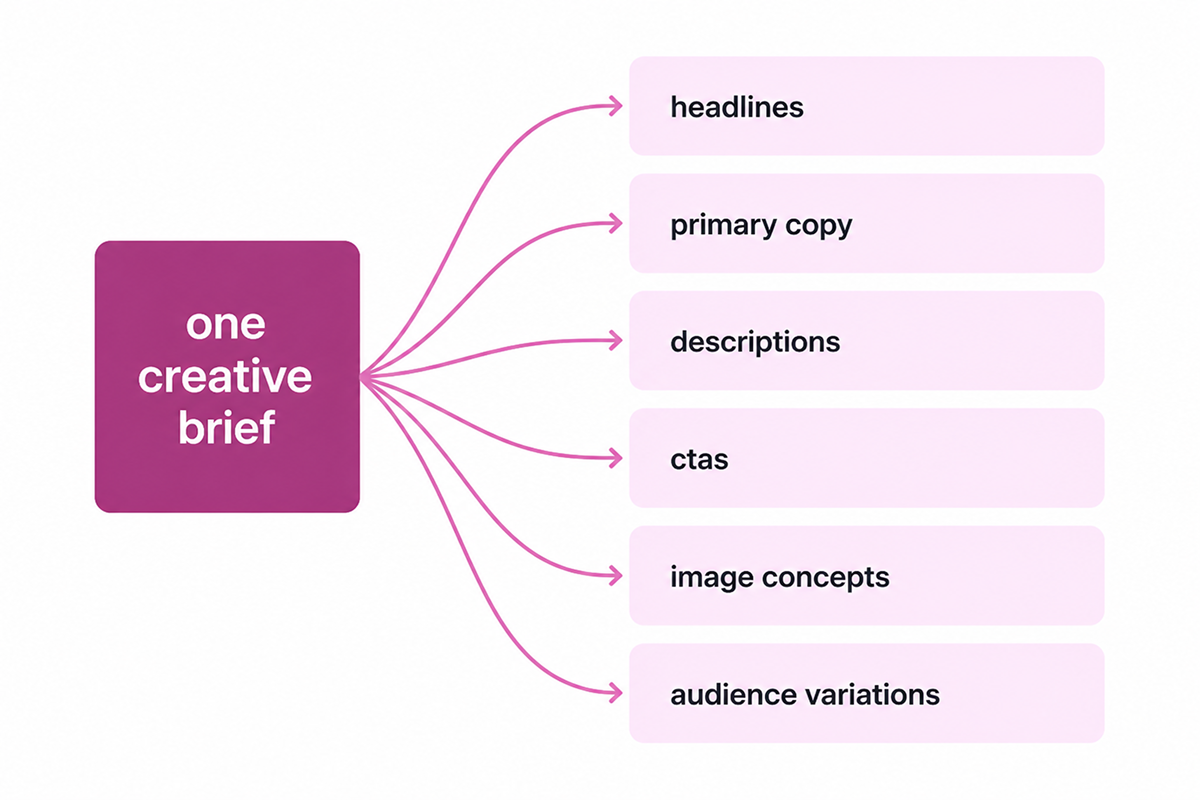
Every successful advertising campaign begins with a creative brief rather than a finished advertisement. This brief typically defines the campaign objective, target audience, product or service, value proposition, brand guidelines, and the desired action, such as generating leads, increasing sales, or driving website traffic.
Ad creative AI uses this information to generate multiple campaign assets instead of a single advertisement. Rather than producing a single headline and description, it creates several creative variations that can be reviewed, refined, and tested before launch.
Depending on the campaign, AI can generate:
-
headlines and long headlines
-
primary advertising copy
-
descriptions for search and display ads
-
social media ad copy
-
calls to action
-
product-focused messaging
-
image concepts and creative prompts
-
alternative creative variations for different audiences
Instead of recreating every asset manually, marketers can use AI ad creative tools to build an initial set of advertising creatives in minutes. The strongest concepts are then refined, approved, and adapted for different platforms, campaign objectives, or audience segments before they become part of the final campaign.
Which Advertising Assets Can AI Generate?
AI is no longer limited to writing advertising copy. Modern AI ad creatives can support almost every stage of creative production, helping marketing teams produce a complete set of campaign assets from a single brief.
|
Advertising asset |
How AI supports creative production |
|---|---|
|
Headlines |
Generates multiple headline variations for search, display, and social media ads, giving marketers more options for testing. |
|
Primary ad copy |
Creates persuasive advertising copy based on the product, audience, and campaign objective while maintaining a consistent message. |
|
Descriptions |
Produces short and long descriptions suitable for responsive search ads, display campaigns, and e-commerce advertising. |
|
Calls to action |
Suggests different CTAs based on campaign goals, such as purchases, registrations, inquiries, downloads, or demonstrations. |
|
Creative concepts |
Generates multiple messaging angles that highlight different product benefits, customer pain points, or value propositions. |
|
Image prompts |
Creates detailed prompts for AI image generation and visual advertising concepts aligned with the campaign brief. |
|
Audience-specific variations |
Adapts the same advertisement for different customer segments without changing the overall campaign message. |
|
Platform-specific creatives |
Adapts advertising content for Google Ads, Meta Ads, LinkedIn Ads, and other digital channels. |
Producing multiple creative variations from the same campaign brief makes testing significantly more effective. Instead of relying on a single advertisement, marketers can compare different headlines, messaging, visuals, and calls to action to identify which AI-generated ad creative delivers the strongest engagement and conversion performance.
Create Ads with AI Without Losing Creative Control
AI can generate advertising assets quickly, but successful campaigns still depend on clear creative direction and human judgment. Campaign objectives, audience insights, brand positioning, and compliance requirements should always guide the creative process.
A practical workflow combines AI with editorial review:
-
Define the campaign objective and target audience.
-
Generate multiple headlines, descriptions, visuals, and calls to action using AI.
-
Review every creative against brand guidelines and campaign goals.
-
Refine the strongest concepts instead of accepting the first output.
-
Approve the final creative set before launching the campaign.
-
Measure performance and use the results to improve future creative variations.
This process allows marketing teams to create ads with AI without compromising quality or consistency. AI produces ideas and first drafts, while marketers decide which concepts best communicate the brand's value proposition and support the campaign objective.
The most effective AI-powered ad creatives are continuously refined using campaign performance, customer feedback, and A/B testing to improve click-through rates, engagement, and conversions over time.
Why AI Improves Creative Testing
High-performing advertising campaigns rarely rely on a single creative. Different audiences respond to different headlines, visuals, offers, and calls to action, making continuous testing an essential part of campaign management.
AI makes this process significantly faster by generating multiple creative variations from the same campaign brief. Instead of manually rewriting advertisements, marketers can test different value propositions, emotional triggers, headline structures, image concepts, and CTAs while keeping the campaign objective consistent.
AI simplifies creative testing by automatically:
|
AI capability |
How it supports creative testing |
|---|---|
|
Rewriting ads for different audiences |
Tailors messaging for new prospects, returning customers, decision-makers, or specific market segments while preserving the campaign's core message. |
|
Generating multiple creative variations |
Produces alternative headlines, descriptions, visuals, and CTAs for A/B testing. |
|
Adjusting tone and messaging |
Refines content for professional, promotional, educational, or conversational advertising styles. |
|
Creating alternative headlines |
Generates multiple headline options that emphasize different product benefits or customer pain points. |
|
Suggesting different value propositions |
Highlights different competitive advantages, features, or outcomes to identify the messaging that resonates best with the target audience. |
|
Refining calls to action |
Creates platform-appropriate CTAs designed to increase clicks, inquiries, registrations, purchases, or downloads. |
Instead of testing one or two creative concepts, marketers can evaluate a much broader range of advertising variations and use performance data to identify which combinations generate the highest engagement, click-through rates, and conversions.
Features That Matter Most in Ad Creative AI Platforms
The best ad creative AI platforms do more than generate advertising copy. They support the entire creative workflow, from developing campaign ideas to organizing assets, reviewing content, and preparing creatives for launch.
When evaluating a platform, look for capabilities such as:
|
Feature |
How it supports ad creative production |
|---|---|
|
AI copy generation |
Produces headlines, primary text, descriptions, and calls to action for search, display, and social media advertising. |
|
Creative variations |
Generates multiple versions of the same advertisement for different audiences, offers, or A/B tests. |
|
Brand-aware image generation |
Creates ad visuals in your own brand colors and logo, so creative arrives on-brand instead of generic. |
|
Brand voice controls |
Keeps generated content aligned with brand guidelines, messaging, and tone of voice across every campaign. |
|
Creative asset management |
Organizes advertising copy, images, videos, and approved creatives so they can be reused across future campaigns. |
|
Collaboration and approvals |
Allows copywriters, designers, marketers, and stakeholders to review, edit, comment on, and approve creatives before launch. |
|
Campaign organization |
Groups creatives by campaign, audience, product, or advertising channel, making it easier to manage large volumes of content. |
|
Direct publishing |
Publishes finished creatives straight to the connected ad platform, so approved ads go live without switching tools. |
AI-generated creatives deliver the greatest value when they are part of a broader paid advertising workflow that connects creative production, publishing, and campaign results instead of treating each activity separately.
Brand-Aware Ad Creative Is the Real Differentiator
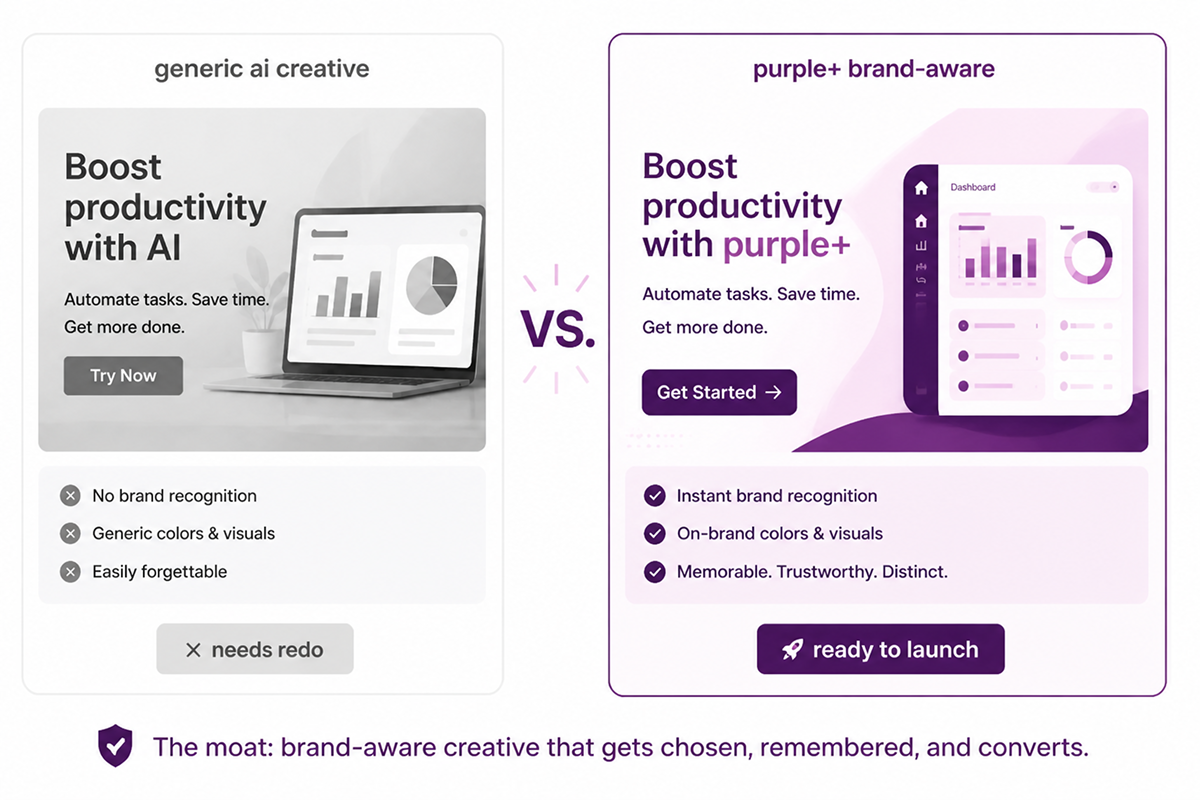
Almost every AI tool can write ad copy. Far fewer can generate the visual in your own brand colors and logo. Generic AICreative that ignores your brand identity still needs a designer to rework it before launch, which removes much of the time saved.
Purple+ generates ad images using your brand colors and logo, pulled from your workspace's brand memory, so creative arrives ready to review rather than ready to redo. That difference compounds across every variation, every platform, and every campaign.
AI Ad Creative for Google Ads
Google Ads campaigns often require far more creative assets than advertisers expect. A single Responsive Search Ad can include up to 15 headlines and 4 descriptions, while Performance Max and Display campaigns require multiple text and visual assets to serve across Google's advertising inventory.
Creating these variations manually is time-consuming, particularly when managing multiple products, services, or campaigns.
AI can generate headline variations, descriptions, promotional messaging, and calls to action from a single campaign brief. Instead of writing every asset individually, marketers can review AI-generated options, refine the strongest creatives, and build more comprehensive campaigns in less time.
Creating multiple advertising assets is only the first step. Once approved, those creatives can be published directly to your account as part of a Google Ads management workflow, where results come back into one place and new variations can be generated whenever performance data suggests a creative refresh.
How to Build an AI-Powered Ad Creative Workflow
Creating ads with AI is most effective when it follows a structured workflow rather than generating individual assets on demand. Every campaign should begin with a clear creative brief, followed by AI-assisted content generation, creative review, testing, and continuous refinement.
A practical workflow includes:
-
Define the campaign objective, target audience, offer, and key message.
-
Generate multiple headlines, descriptions, visuals, and calls to action with AI.
-
Review every creative for accuracy, compliance, and alignment with brand guidelines.
-
Select the strongest creative variations for different advertising platforms and audience segments.
-
Publish the approved creatives and launch the campaign.
-
Use campaign results to refresh underperforming creatives and generate new variations to test.
Purple+ brings the ad creative workflow together in a single workspace. It helps marketing teams generate AI-powered headlines, descriptions, calls to action, and creative variations; produce ad visuals in your own brand colors and logo; organize assets by campaign; collaborate on creative reviews; manage approvals; and publish platform-specific ad creatives to Google, Meta, and LinkedIn from one place.
As campaigns run, Purple+ makes it easy to generate new ad variations and replace underperforming creatives, then brings spend, clicks, and conversions back into the Results tab so the next round of creative is informed by real data. New variations can be generated, approved, and published without rebuilding campaigns from scratch.
Advertising is only one part of a successful AI-driven marketing strategy. Understanding how to use AI for marketing can help businesses apply AI across content creation, SEO, social media, email marketing, campaign planning, and other marketing activities to build more efficient workflows.
Frequently asked questions
Written by
AI & SEO Content writer
Tetiana Reusche is an SEO Content Strategist and AI marketing specialist who specialises in creating content that helps businesses improve their online visibility and turn organic traffic into business growth. Her work combines search strategy, content marketing, and AI-driven optimisation to produce content that performs across search engines, answer engines, and modern AI-powered discovery platforms. Over the years, she has developed SEO strategies and content frameworks for companies in the SaaS, software, miltech, travel, real estate, home renovation, lifestyle, and entertainment industries. She enjoys translating complex topics into practical, engaging content that is valuable for both readers and search engines. Tetiana focuses on building topical authority through strategic keyword research, content planning, search intent analysis, and well-structured content ecosystems. She regularly creates keyword clusters, content recommendations, editorial roadmaps, and SEO strategies that help brands reach the right audience, strengthen their authority, and generate meaningful business results. Her articles explore SEO, AI-powered marketing, social media management, content strategy, and digital growth, with a practical focus on helping businesses create discoverable, useful content designed to convert.