AI in B2B Marketing: How AI Supports Sales and Marketing

AI in B2B marketing is being used to analyse customer data, identify high-value accounts, personalise campaigns, qualify leads and improve marketing performance. Its role extends beyond content generation: machine learning can identify patterns across CRM data, website activity, campaign engagement and sales interactions.
B2B marketing creates a particular challenge for AI systems because purchasing decisions often involve several people, long sales cycles and multiple interactions before a deal closes. AI can help connect these signals and give marketing and sales teams better information for prioritisation, targeting and decision-making.
What Is AI in B2B Marketing?
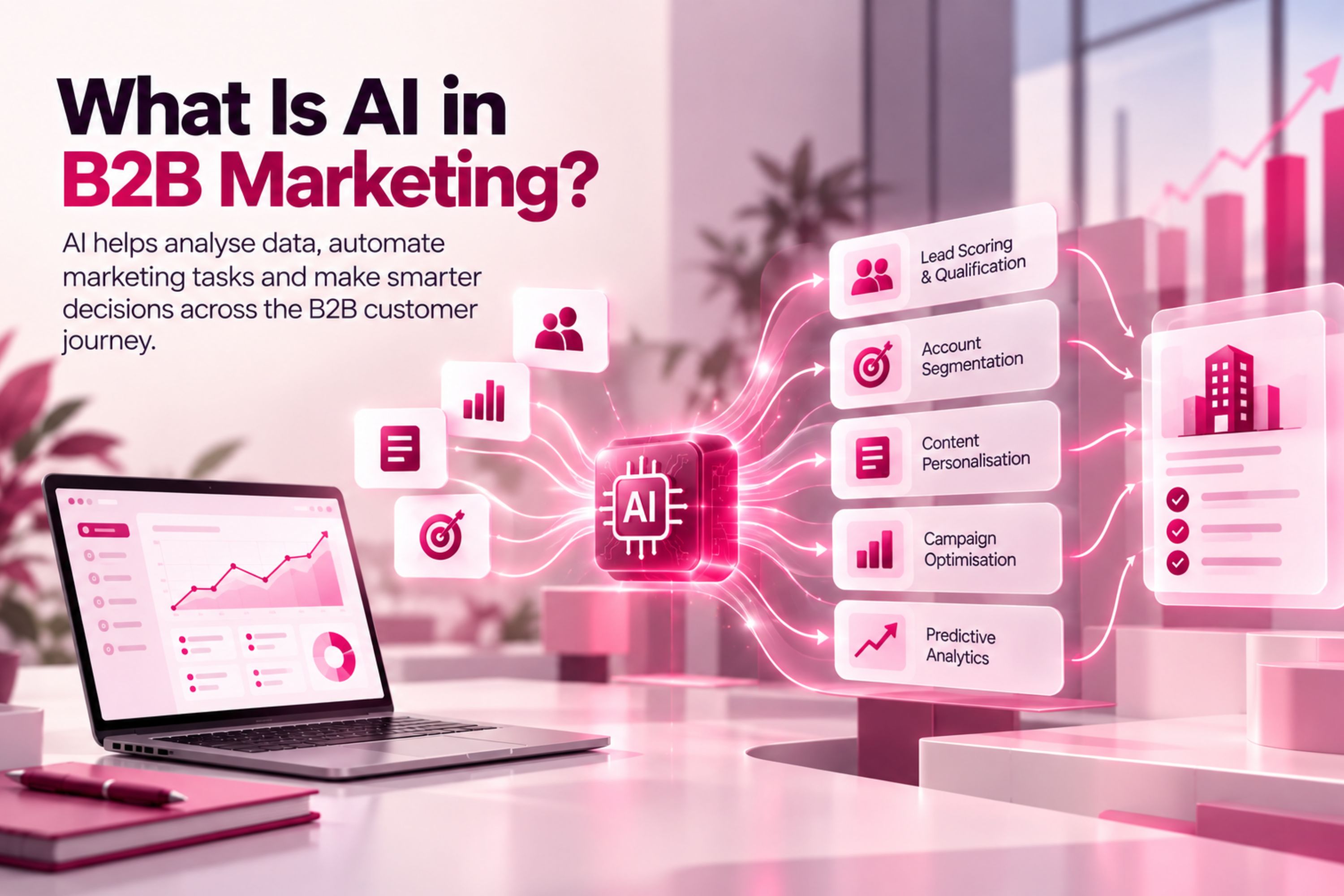
AI in B2B marketing refers to using artificial intelligence to analyse data, automate marketing tasks, and support decisions throughout the B2B customer journey.
Common applications include:
-
lead scoring and qualification
-
account segmentation
-
customer and market analysis
-
content personalisation
-
campaign optimisation
-
predictive analytics
-
sales forecasting
-
marketing automation
-
customer intent analysis
The technology can range from machine learning models that predict conversion probability to generative AI systems that produce content or summarise customer information.
AI's main value is its ability to process large datasets and identify patterns at a scale that would be difficult to manage manually.
How AI Is Used in B2B Marketing
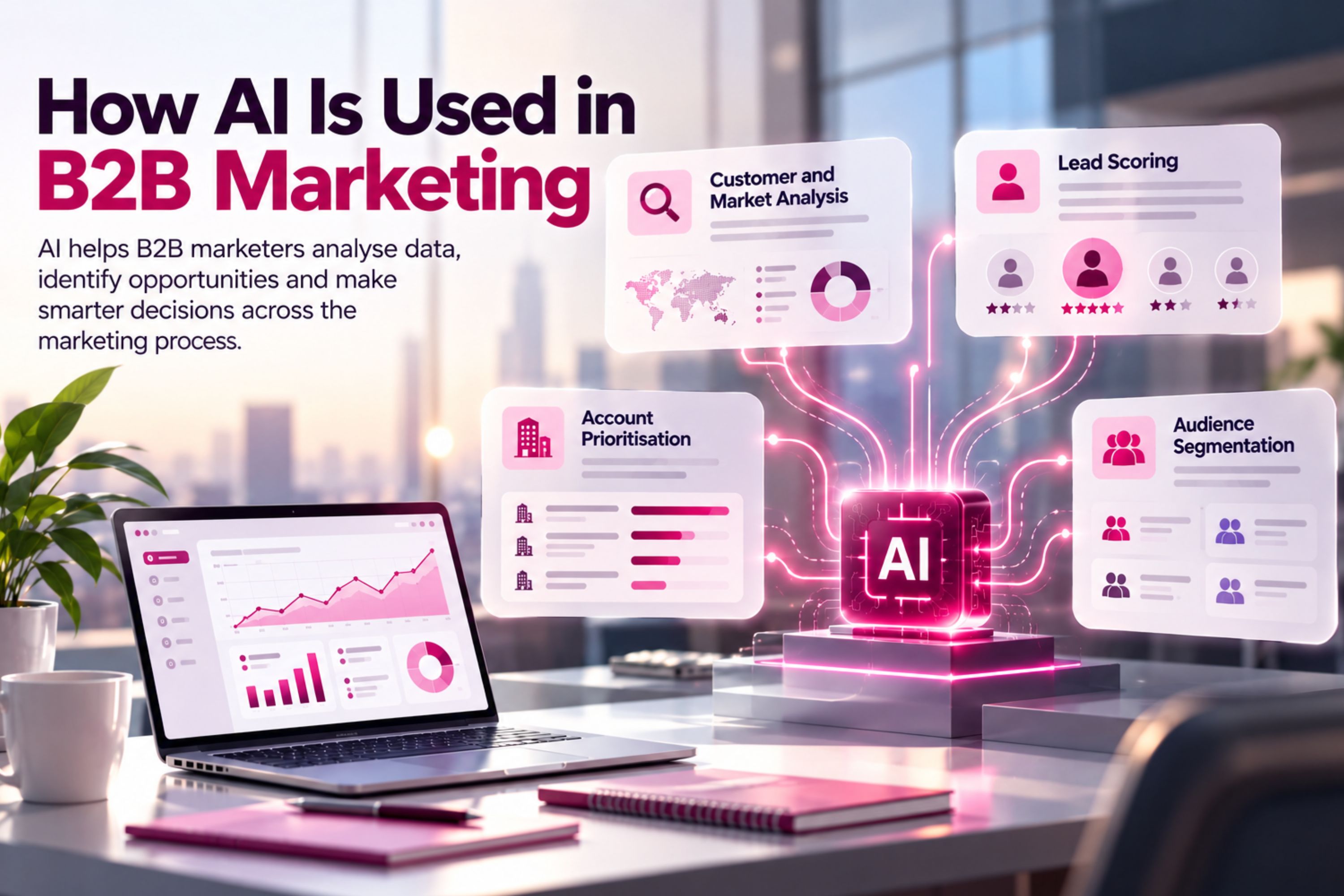
AI can support different stages of B2B marketing, but not all applications are equally valuable. The strongest use cases usually involve repetitive analysis, large datasets or decisions that require multiple signals.
Customer and Market Analysis
B2B marketers collect information from CRM systems, websites, advertising platforms, email campaigns, sales conversations and customer databases.
AI can analyse this information to identify customer segments, recurring behaviour patterns and changes in engagement. It can also classify large amounts of unstructured information, such as notes from sales calls or customer enquiries.
This can reduce manual research and help marketers identify patterns that might otherwise remain in separate datasets.
Lead Scoring
AI can analyse historical customer data to identify characteristics associated with successful leads.
A B2B lead scoring model may consider:
-
company size
-
industry
-
job role
-
website activity
-
content engagement
-
email interactions
-
previous sales activity
-
product interest
-
historical conversion data
The system can then assign a score or probability to help sales teams prioritise leads.
This is different from simply counting interactions. A prospect who downloads five documents is not automatically more valuable than one who visits a pricing page once. AI can combine different signals instead of treating every interaction equally.
Account Prioritisation
Account-based marketing creates another application for B2B AI.
Instead of evaluating individual leads in isolation, AI can analyse activity across an entire company. Multiple employees from the same organisation may visit the website, interact with content or respond to campaigns without being connected to the same contact record.
Account-level analysis can help identify organisations showing increased engagement and distinguish them from accounts with little recent activity.
Audience Segmentation
AI can identify patterns across firmographic and behavioural data to create more detailed B2B audience segments.
Segments can be based on factors such as industry, company size, technology stack, geographic market, customer lifecycle stage or engagement behaviour.
This can improve campaign relevance without requiring marketers to manually define every possible combination of customer characteristics.
AI B2B Marketing and Personalisation
Personalisation in B2B marketing needs to account for more than a contact's name or job title.
A useful personalisation system can combine information about the company, industry, previous interactions, products viewed and stage of the buying process.
For example, an early-stage prospect may need educational content about a business problem, while an account evaluating suppliers may need product specifications, implementation information, pricing or comparisons.
AI can help select relevant content or generate variations for different segments. The quality of the result depends on the accuracy of the customer data and the rules used to determine relevance.
B2B AI for Predictive Marketing
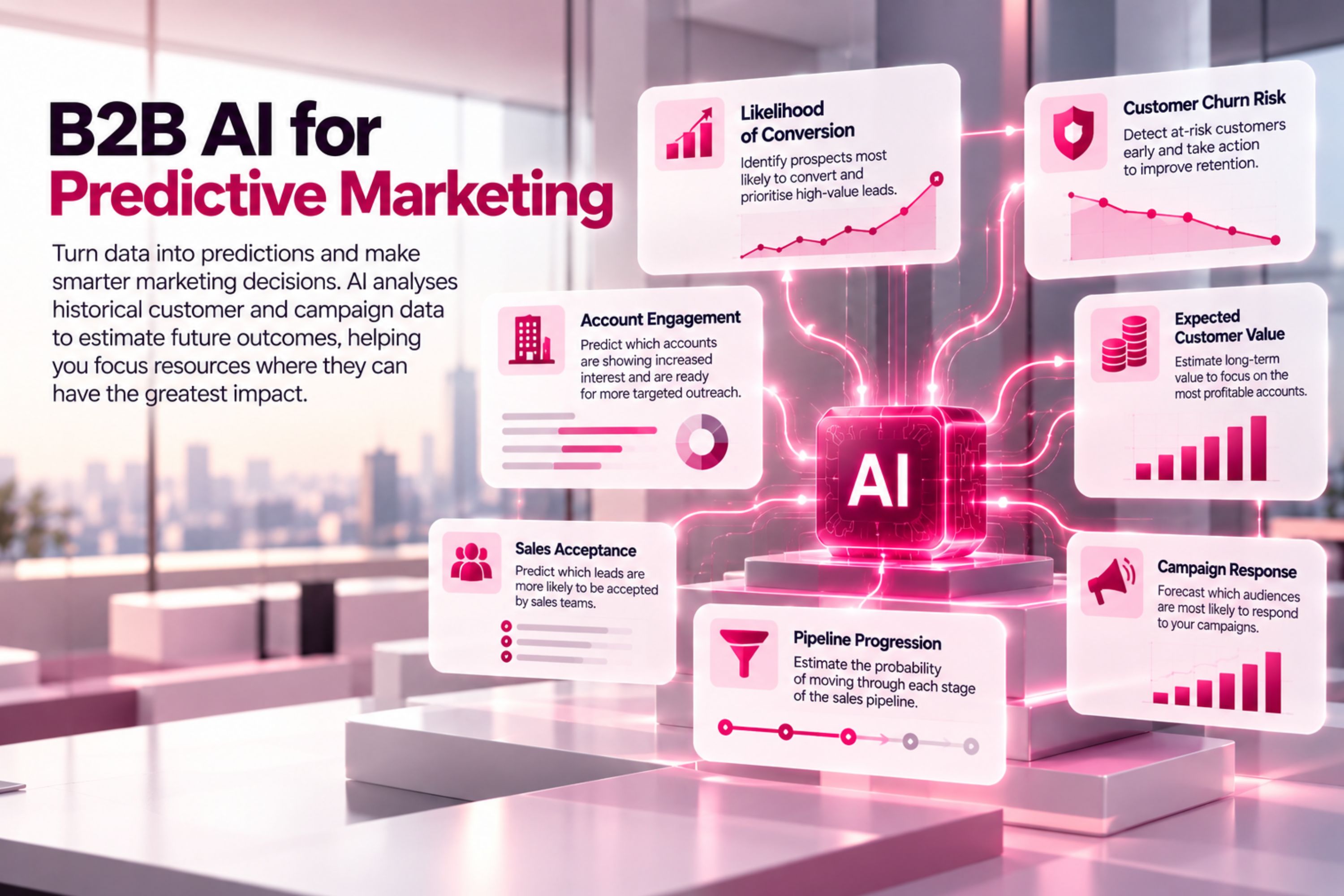
B2B AI can predict outcomes from historical customer and campaign data.
Predictive models may estimate:
-
likelihood of conversion
-
customer churn risk
-
expected customer value
-
likelihood of sales acceptance
-
campaign response
-
account engagement
-
probability of progressing through the sales pipeline
These predictions can help teams allocate resources more efficiently.
However, a prediction is not a fact about an individual prospect. It is an estimate based on patterns in available data, and teams should evaluate its accuracy against actual outcomes.
AI in B2B Sales and Marketing
AI in B2B sales and marketing becomes particularly useful when customer information is shared across both functions.
Marketing may have information about content consumption, campaign engagement and website behaviour. Sales may have information about customer requirements, objections, purchasing timelines and conversations with decision-makers.
When these datasets are connected, AI can analyse signals across the customer journey instead of treating marketing and sales activity as separate processes.
This is where artificial intelligence in sales and marketing can have a practical impact: the same customer information can support lead qualification, account prioritisation, campaign targeting and sales preparation.
AI for Marketing and Sales
AI for marketing and sales covers use cases across the customer acquisition process.
Marketing applications include:
-
audience research
-
content creation
-
campaign analysis
-
lead scoring
-
segmentation
-
personalisation
-
marketing attribution
Sales applications include:
-
prospect research
-
account prioritisation
-
lead qualification
-
sales forecasting
-
meeting preparation
-
CRM data analysis
-
follow-up prioritisation
The strongest implementations connect these use cases rather than creating isolated automation.
For example, marketing can identify an account with increasing engagement and pass relevant context to sales. Sales can then use the account's activity alongside its own customer knowledge to decide how to approach the prospect.
AI for Sales and Marketing: Lead Handoff
One common B2B problem is the transition between marketing-generated leads and sales activity.
A lead may meet marketing's qualification criteria but still have little commercial value. Conversely, an account that does not meet a simple lead-scoring threshold may show strong buying signals across several contacts.
AI for sales and marketing can analyse multiple signals to improve lead routing and prioritisation.
Instead of relying only on a single score, teams can combine firmographic information, engagement behaviour, account activity and historical conversion patterns.
This can help reduce the number of poorly qualified leads passed to sales while making high-value opportunities easier to identify.
Sales and Marketing AI: Content and Communication
Sales and marketing AI can also support content production and customer communication.
Generative AI can create first drafts of:
-
email campaigns
-
landing page copy
-
sales emails
-
product descriptions
-
case study outlines
-
social media content
-
ad variations
-
sales enablement materials
For B2B organisations, the important issue is not simply how quickly content can be produced. Content still needs accurate product information, appropriate positioning and industry-specific language.
AI-generated content therefore works best when it is based on reliable company information and reviewed before publication or customer use.
AI can also support paid campaign creative, where ad creative AI can generate and test variations of headlines, descriptions, visuals and other advertising assets for different audiences.
Sales and Marketing With AI: Automating Repetitive Work
Sales and marketing with AI can reduce manual work in processes that involve classification, summarisation or repeated analysis.
Examples include:
-
summarising sales calls
-
categorising leads
-
routing enquiries
-
updating CRM fields
-
generating campaign reports
-
identifying inactive accounts
-
preparing prospect summaries
-
creating content variations
-
analysing campaign performance
Automation is most suitable when the task follows clear rules and the consequences of an incorrect decision are controllable.
Tasks involving negotiations, strategic positioning or sensitive customer relationships require more human involvement.
Artificial Intelligence Sales and Marketing Applications
Artificial intelligence sales and marketing applications fall into several core areas.
Predictive Analytics
Machine learning models can analyse historical data to identify patterns associated with customer behaviour and commercial outcomes.
Marketing teams can use these predictions for lead scoring, segmentation and campaign planning. Sales teams can use them for account prioritisation, forecasting and churn analysis.
Recommendation Systems
AI can recommend content, products or next actions based on customer behaviour and historical patterns.
In B2B, recommendations can determine which resources may be relevant to an account or which action should follow a particular interaction.
Conversation Analysis
AI can analyse transcripts, emails and other customer interactions to identify recurring topics, objections, questions and customer requirements.
This information can improve sales enablement and highlight themes that should influence marketing content.
Campaign Optimisation
AI can analyse campaign performance across audiences, channels and creative assets.
Instead of reviewing every metric manually, marketers can use automated analysis to spot significant changes and areas that need investigation.
Artificial Intelligence in Sales and Marketing
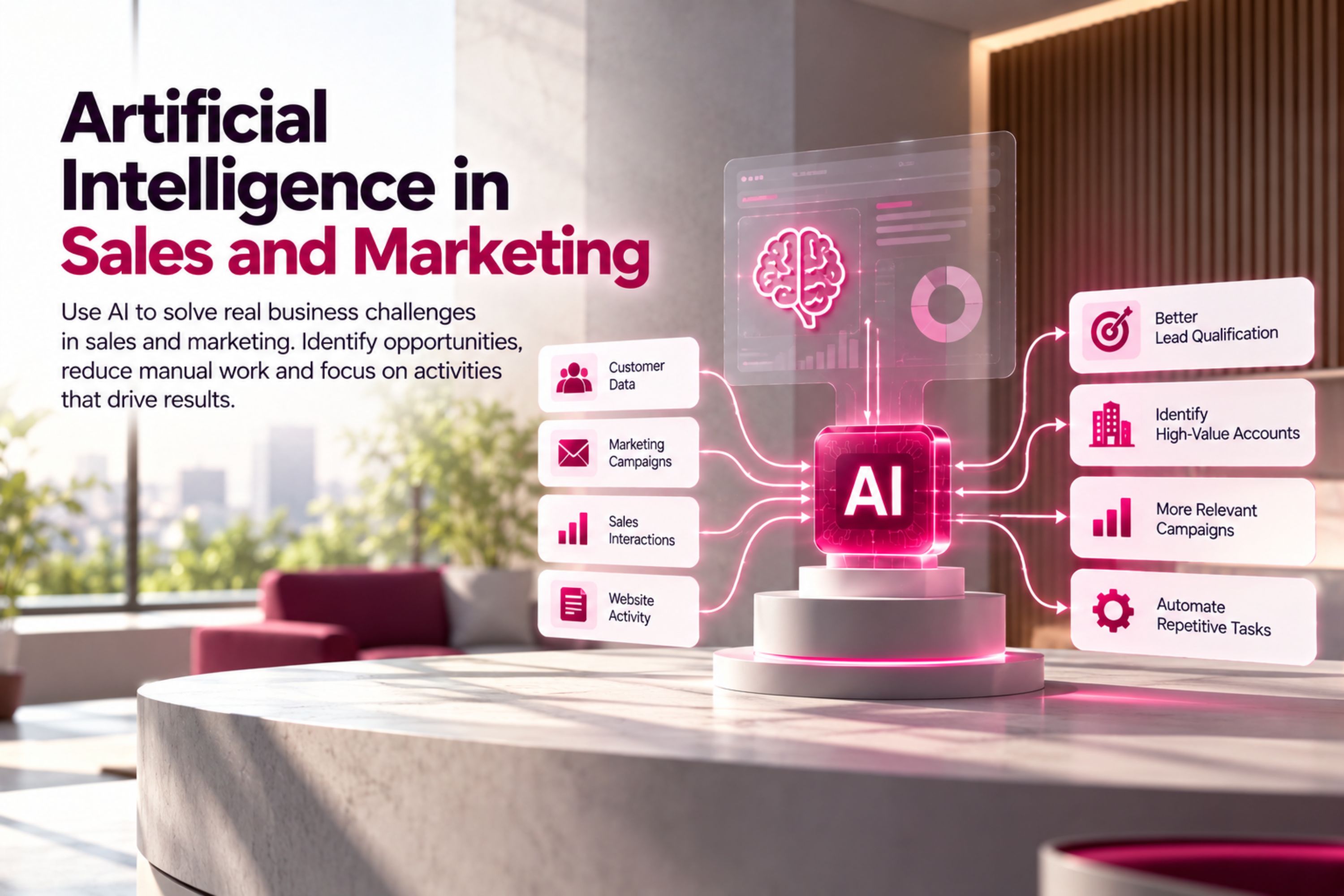
Artificial intelligence in sales and marketing is most useful when it addresses a defined operational problem.
For example, a company may use AI to reduce the time required to qualify leads, identify accounts showing increased buying activity or analyse thousands of customer interactions.
Start implementation with the business process rather than the technology. A company that cannot define what should improve will struggle to determine whether an AI system is producing useful results.
AI-Assisted Sales and Marketing
AI-assisted sales and marketing combines automated analysis or content generation with human review.
This model is particularly relevant to B2B because customer decisions often depend on information that structured data cannot fully capture.
An AI system may identify an account with increased engagement, but a salesperson still needs to consider the company's current situation, existing relationship and commercial priorities.
The same applies to content. AI can produce a draft, but subject-matter experts need to verify technical claims, product details and industry-specific information.
B2B Machine Learning
B2B machine learning uses historical data to identify patterns and make predictions relevant to business customers.
Common applications include:
-
lead scoring
-
customer segmentation
-
churn prediction
-
account prioritisation
-
sales forecasting
-
campaign optimisation
-
recommendation systems
-
customer lifetime value prediction
Machine learning models require relevant historical data for training and evaluation.
Data problems can therefore become model problems. Inconsistent CRM records, missing conversion information or changes in how leads are classified can affect prediction quality.
B2B Machine Learning vs Generative AI
B2B machine learning and generative AI serve different purposes.
Machine learning is commonly used for prediction, classification and pattern recognition. Generative AI is designed to produce new content such as text, images, summaries or other outputs.
A B2B marketing workflow can use both. A machine learning model may identify high-value accounts, while generative AI creates content tailored to those accounts.
AI in B2B Customer Journey Analysis
B2B buyers often interact with a company through multiple channels before contacting sales.
A typical journey may include:
-
Searching for information about a business problem.
-
Reading educational content.
-
Downloading a resource.
-
Returning to the website.
-
Reviewing product information.
-
Contacting the company.
-
Speaking with a salesperson.
-
Comparing suppliers.
AI can analyse these interactions to identify patterns in account behaviour.
This can help marketers determine which content is associated with different stages of the buying process and where prospects commonly disengage.
It can also help sales teams distinguish between casual research and stronger engagement signals.
AI in B2B Marketing Analytics
AI can make B2B marketing analytics more useful by analysing relationships between multiple variables rather than reporting isolated metrics.
A dashboard may show that traffic increased, but AI-assisted analysis can help investigate which accounts generated that traffic, which channels contributed to it and whether those accounts later engaged with sales.
Useful B2B marketing metrics can include:
-
marketing-qualified leads
-
sales-qualified leads
-
pipeline generated
-
customer acquisition cost
-
conversion rate
-
revenue by channel
-
account engagement
-
customer lifetime value
AI does not replace measurement strategy. It improves the ability to process and interpret the available data.
AI in B2B Marketing Automation
AI can make marketing automation more adaptive by using customer behaviour to determine what happens next.
Traditional automation often follows predefined rules:
If X happens → perform Y.
AI-supported automation can use additional signals to determine the most appropriate action.
For example, an account that repeatedly engages with technical content may receive different communication than an account that primarily interacts with pricing information.
This type of workflow is part of AI marketing automation, where AI can support customer analysis, segmentation, content generation and campaign workflows rather than simply triggering predefined actions.
The underlying automation still needs clear rules, data access and appropriate controls.
Artificial Intelligence and Machine Learning in Digital Marketing
Artificial intelligence and machine learning in digital marketing are closely related but should not be treated as identical terms.
Artificial intelligence is the broader category covering systems that perform tasks involving prediction, classification, generation or automated decision-making.
Machine learning is one approach for building AI systems. It allows models to identify patterns in data and make predictions based on those patterns.
In digital marketing, machine learning can support lead scoring, audience modelling, recommendation systems and campaign optimisation, while generative AI can support content production and creative development.
Data Requirements for AI in B2B
AI in B2B depends on the data available to the system.
Relevant data can include:
-
CRM records
-
firmographic information
-
website activity
-
advertising interactions
-
email engagement
-
sales activity
-
transaction history
-
customer service interactions
-
product usage
-
content consumption
Data integration is a major consideration. If marketing, sales, and customer data are stored in disconnected systems, an AI model may see only part of the customer journey.
Data quality is equally important. Duplicate records, missing fields and inconsistent classifications can affect segmentation, lead scoring and predictive models.
Challenges of AI in B2B Marketing
AI adoption creates several practical challenges.
Poor Data Quality
AI cannot compensate for inaccurate or incomplete source data. CRM records and conversion tracking need to be reliable before they are used for predictive analysis.
Privacy and Governance
B2B companies may process personal information, confidential business data and commercially sensitive customer records. Data access, retention and AI usage need clear controls.
Incorrect Predictions
A model can identify statistical patterns without understanding the full business context. Test predictions against actual outcomes.
Integration Problems
AI tools become less useful when they operate separately from the CRM, marketing automation platform, analytics systems and sales workflow.
Over-Automation
Not every B2B marketing decision should be automated. Strategic positioning, complex customer communication and high-value sales relationships often require human judgement.
How to Implement AI in B2B Marketing
A practical AI implementation should begin with a specific process rather than a general goal of “using AI”.
1. Identify a Business Problem
Choose a measurable problem such as low lead qualification efficiency, slow reporting or manual account research.
2. Audit the Data
Determine what information is available, where it is stored and whether it is accurate enough for the intended use case.
3. Select the Appropriate AI Application
Different problems require different technologies. Lead scoring may require predictive modelling, while content production may use generative AI.
4. Test the Workflow
Start with a controlled use case and compare its results with the existing process.
5. Measure the Outcome
Use business metrics rather than AI output volume. A successful implementation should improve a measurable process such as lead quality, response time, conversion rate or marketing efficiency.
6. Expand Carefully
Once a use case demonstrates value, integrate it into broader marketing and sales workflows.
You can use AI for marketing across content, campaigns, analytics, and other marketing processes, but the specific B2B use case should remain tied to a measurable business objective.
What Is the Role of AI in B2B Marketing?
AI is becoming an operational tool across B2B marketing, sales and customer analysis. Its most useful applications involve processing large amounts of information, identifying patterns, predicting outcomes and automating repetitive tasks.
The technology can help B2B teams qualify leads, prioritise accounts, personalise communication, analyse campaigns and connect marketing activity with sales outcomes.
The quality of these applications depends on reliable data, clear objectives and appropriate human oversight. AI can speed up and scale analysis, but the resulting decisions still need to be evaluated against real customer behaviour and business results.
Frequently asked questions
Written by
AI & SEO Content writer
Tetiana Reusche is an SEO Content Strategist and AI marketing specialist who specialises in creating content that helps businesses improve their online visibility and turn organic traffic into business growth. Her work combines search strategy, content marketing, and AI-driven optimisation to produce content that performs across search engines, answer engines, and modern AI-powered discovery platforms. Over the years, she has developed SEO strategies and content frameworks for companies in the SaaS, software, miltech, travel, real estate, home renovation, lifestyle, and entertainment industries. She enjoys translating complex topics into practical, engaging content that is valuable for both readers and search engines. Tetiana focuses on building topical authority through strategic keyword research, content planning, search intent analysis, and well-structured content ecosystems. She regularly creates keyword clusters, content recommendations, editorial roadmaps, and SEO strategies that help brands reach the right audience, strengthen their authority, and generate meaningful business results. Her articles explore SEO, AI-powered marketing, social media management, content strategy, and digital growth, with a practical focus on helping businesses create discoverable, useful content designed to convert.