
Sintra AI Review: What Can Its AI Helpers Actually Do?

Sintra AI can be worth considering if you want help across several parts of a small business, from marketing to everyday administration. This Sintra AI review examines whether its helpers, shared memory and automations fit the work you need to finish—and what to check before paying for a longer subscription.
The appeal is easy to understand. Instead of facing a blank chat window, you choose a helper with a recognisable job and give it a task. The buying decision becomes more useful when you ask which tasks it can complete, which connections it needs and what you still have to check.
Disclosure: Purple+ publishes this review and offers a competing marketing platform. This is a researched assessment of public product documentation checked on 1 October 2026. We have not conducted a hands-on Sintra trial for this article; examples below are illustrative, and we do not claim measured results.
If your priority is recurring marketing, Purple+ is also relevant to your shortlist. We return to that comparison after explaining Sintra on its own terms.
Three key takeaways
-
Sintra covers wider business roles than a marketing-only tool, so assess the jobs you will actually use.
-
Shared business context and supported actions matter more than the number of helper names.
-
Judge affordability by finished, usable work, including revisions and your review time.
Sintra AI review at a glance
Our assessment is that Sintra deserves consideration when your needs span different business functions and you prefer choosing an assistant by role. A named helper may make it easier to begin a task, especially if you are still learning how to brief AI.
That does not tell you how good the finished work will be. Before subscribing, define your required outcome clearly enough that you can recognise success.
|
Your situation |
What to assess in Sintra |
What would justify the purchase? |
|---|---|---|
|
You handle marketing and administration |
Helpers covering both kinds of work |
Several recurring tasks become easier to complete |
|
Your business information is scattered |
Shared context and asset organisation |
Outputs consistently use the correct business facts |
|
You want a recurring social routine |
Creation, review and scheduling |
Approved posts reach the intended accounts |
|
You need an automated process across apps |
Specific actions, permissions and dependencies |
The whole required process works with your accounts |
|
You want someone to own delivery |
Your remaining review and coordination work |
The level of involvement fits your available time |
Treat these as buying criteria, rather than a scorecard we have already completed. Your business may need excellent performance on two tasks more than occasional assistance on twelve.
What do Sintra's 12 helpers cover?
Sintra organises its built-in assistants around business roles. Its published roster spans the following areas:
|
Helper |
Published role |
|---|---|
|
Soshie |
Social media |
|
Penn |
Copywriting |
|
Emmie |
Email marketing |
|
Seomi |
SEO |
|
Milli |
Sales |
|
Buddy |
Business strategy |
|
Commet |
Ecommerce |
|
Dexter |
Data analysis |
|
Cassie |
Customer support |
|
Vizzy |
Executive assistance |
|
Scouty |
Recruitment |
|
Gigi |
Personal development |
Source: Sintra's product overview.
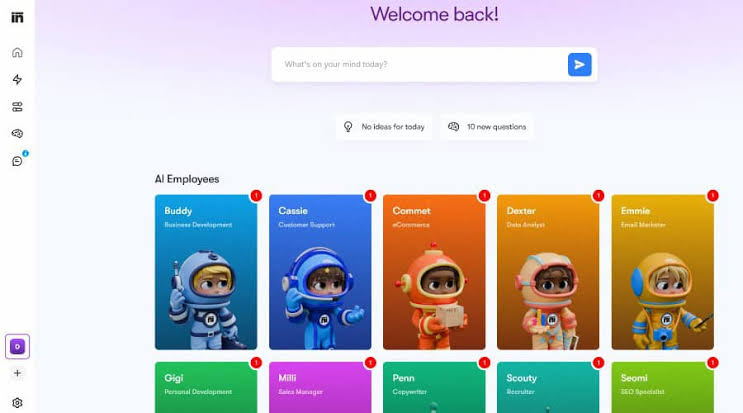
The breadth makes the platform relevant beyond content production. An owner might need a recruitment brief one day and customer-response drafts the next, with marketing tasks in between.
Choose your shortlist of jobs before exploring every helper. Ask what information each job needs, what output you expect and where that output must go. An attractive roster is useful only if it maps to work you already need doing.
For example, a sales email draft still needs the correct offer and recipient context. An analysis needs accurate source data and a defined question. The helper's name is a starting point for the task, not evidence that its answer is ready to use.
How does Brain AI help your business?
Brain AI provides business context for the helpers. Sintra documents support for stored knowledge and brand materials, including reusable notes and a Brand Kit; its guidance also recommends checking information saved into memory for accuracy.
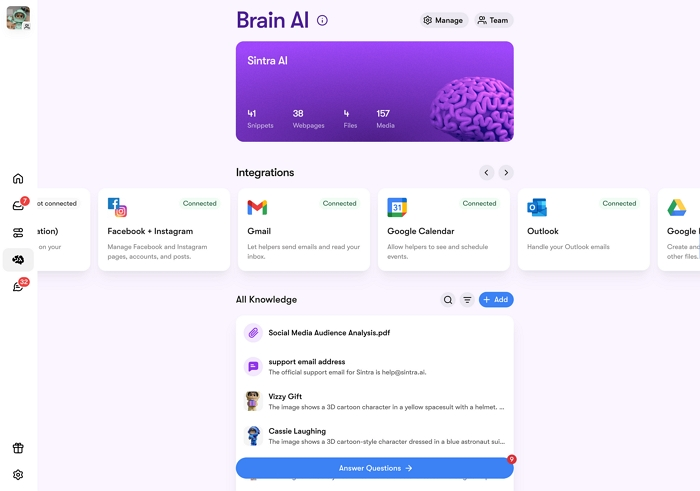
This matters because many disappointing AI drafts start with incomplete inputs. If a system has your old opening hours or a vague description of your audience, polished wording will not fix the underlying mistake.
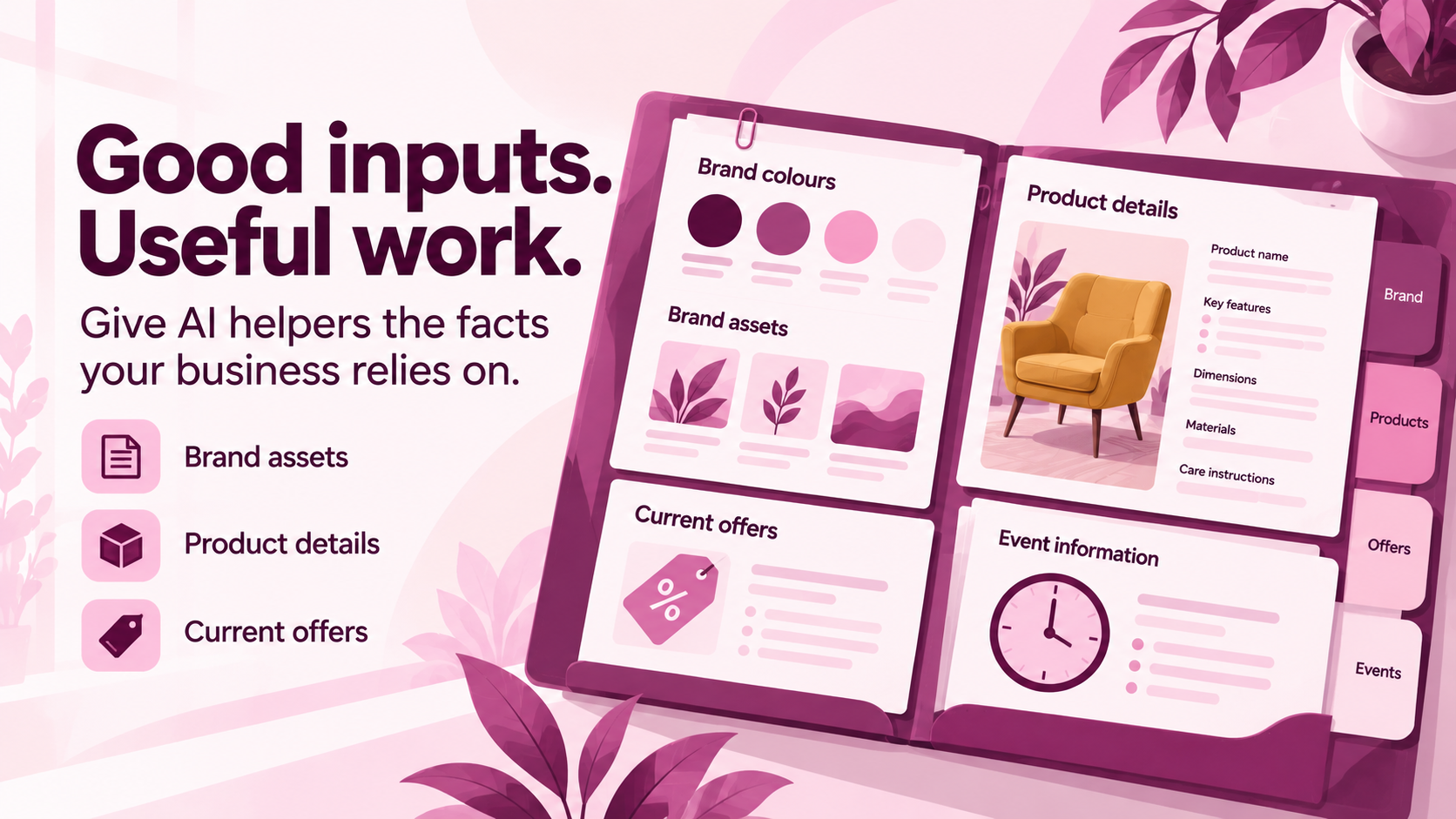
A useful onboarding pack would include your current services, approved product descriptions, logo, brand colours, tone examples and frequently asked questions. Add practical restrictions too: offers you cannot make, phrases you avoid and facts that must never be guessed.
Keep that information current. When an offer expires, update the source material rather than relying on a correction buried in an earlier conversation. Shared memory is most useful when someone takes responsibility for what it contains.
You can read Sintra's Brain AI knowledge guidance for the documented setup. In a trial, deliberately ask two different helpers to use the same business detail and check the outputs yourself.
What can Sintra automate and publish?
Sintra includes connected actions and automation. Its workspace documentation describes integrations and recurring tasks, while also stating that complex, chained workflows have limits. Check the current documentation against the particular process you want to run.
Soshie is a clear example of a supported publishing workflow. Sintra's instructions describe creating or editing post images, producing captions and publishing immediately or scheduling content through its chat interface. That is more than generating suggestions.
For other jobs, separate the requested asset from the requested action. Writing an email, creating a campaign in your email platform and sending it to the intended list are different completion criteria. Test the action you need rather than assuming that a helper's job title covers every step.
Likewise, a connection to an application does not establish support for every object or permission within it. Check your account type, the action you need and whether another person must approve the result.
Our guide to AI marketing automation for small businesses explains how to choose useful recurring tasks. For a trial, choose one routine with a clear finish, then verify that finish in the destination application.
What does Sintra AI cost?
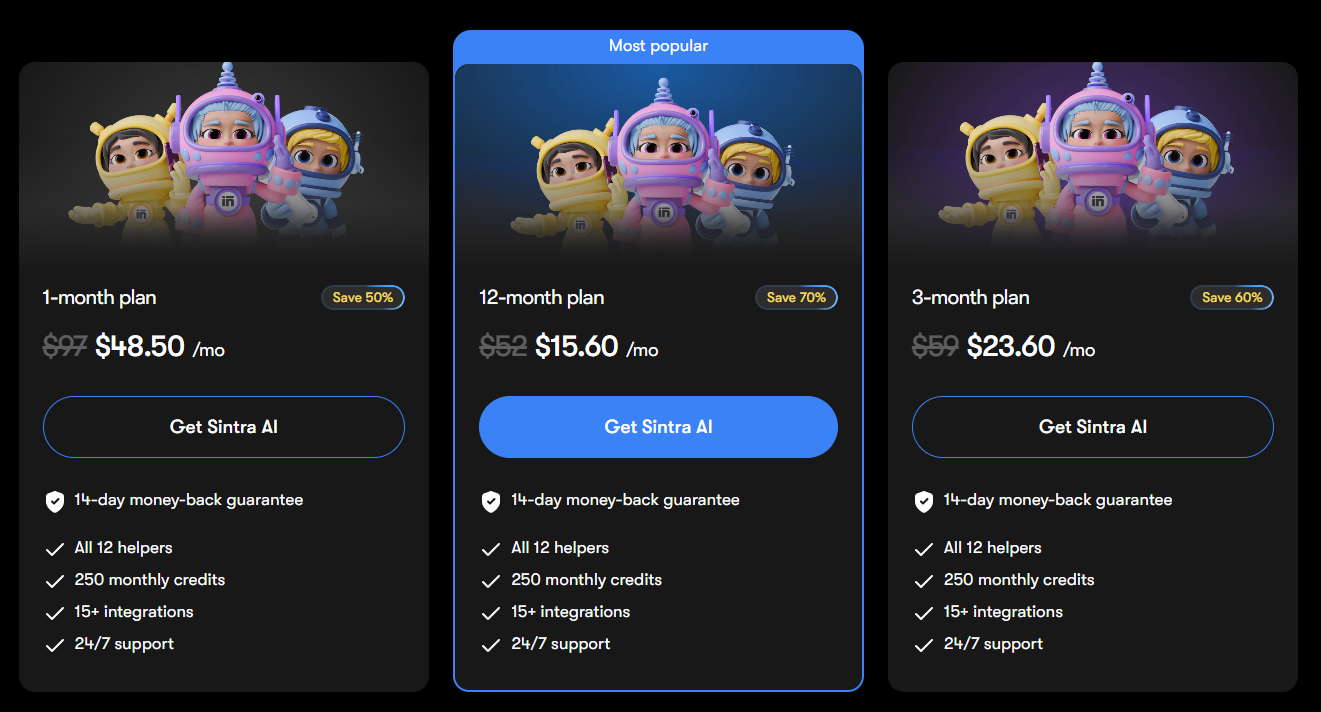
Sintra's public pricing page displayed these offers when checked on 1 October 2026. The discounted amounts are promotional, so they should not be treated as permanent prices.
|
Subscription term |
Advertised promotional monthly equivalent |
Calculated promotional term total |
Displayed reference monthly equivalent |
|---|---|---|---|
|
One month |
$48.50 |
$48.50 |
$97 |
|
Three months |
$23.60 |
$70.80 |
$59 |
|
Twelve months |
$15.60 |
$187.20 |
$52 |
Source: Sintra's current pricing page. Currency: USD. Term totals are arithmetic based on the displayed monthly equivalents, not a checkout quotation. Confirm billing, tax, eligibility and renewal terms before paying.
The three cards list all 12 helpers and 250 monthly credits. A lower monthly equivalent reduces the advertised subscription cost, but makes the term commitment important to the decision.
Choose a billing period after checking fit. A discounted year is good value only if you continue using the platform and the relevant work fits your allowance.
For the wider budgeting question, see our AI marketing software pricing guide. Include the subscriptions you will retain alongside the AI tool when comparing your total costs.
How should you judge its credits and limits?
Sintra's workspace-credit documentation explains that usage depends on actions. It distinguishes content creation from scheduling and publishing, and says AI helpers stop working when a workspace has no remaining credits.
The documentation also describes paid credit additions with recurring billing implications. Check the amount due now and the next renewal rather than assuming an addition is a one-off purchase.
The practical question is how much your own routine consumes. Record the starting balance, complete a defined set of tasks and record the remaining balance. Include edits, retries and follow-up questions in the same trial.
Do not compare two products simply by counting their credits. Each product defines its own unit, so a larger allowance does not automatically represent more finished content.
A useful measure is the subscription and extra usage required to produce the work you actually accept. Keep your editing time beside that figure. A draft that needs substantial rewriting has a cost even if generating it was inexpensive.
A practical example: one business, several jobs
Consider a small furniture shop launching a weekend showroom event. The owner needs social posts, an invitation email, answers to likely customer questions and a short staff briefing.
This is an illustrative evaluation brief, not a completed Sintra test. It is designed to reveal how the platform handles several business tasks without turning the assessment into twelve unrelated demonstrations.
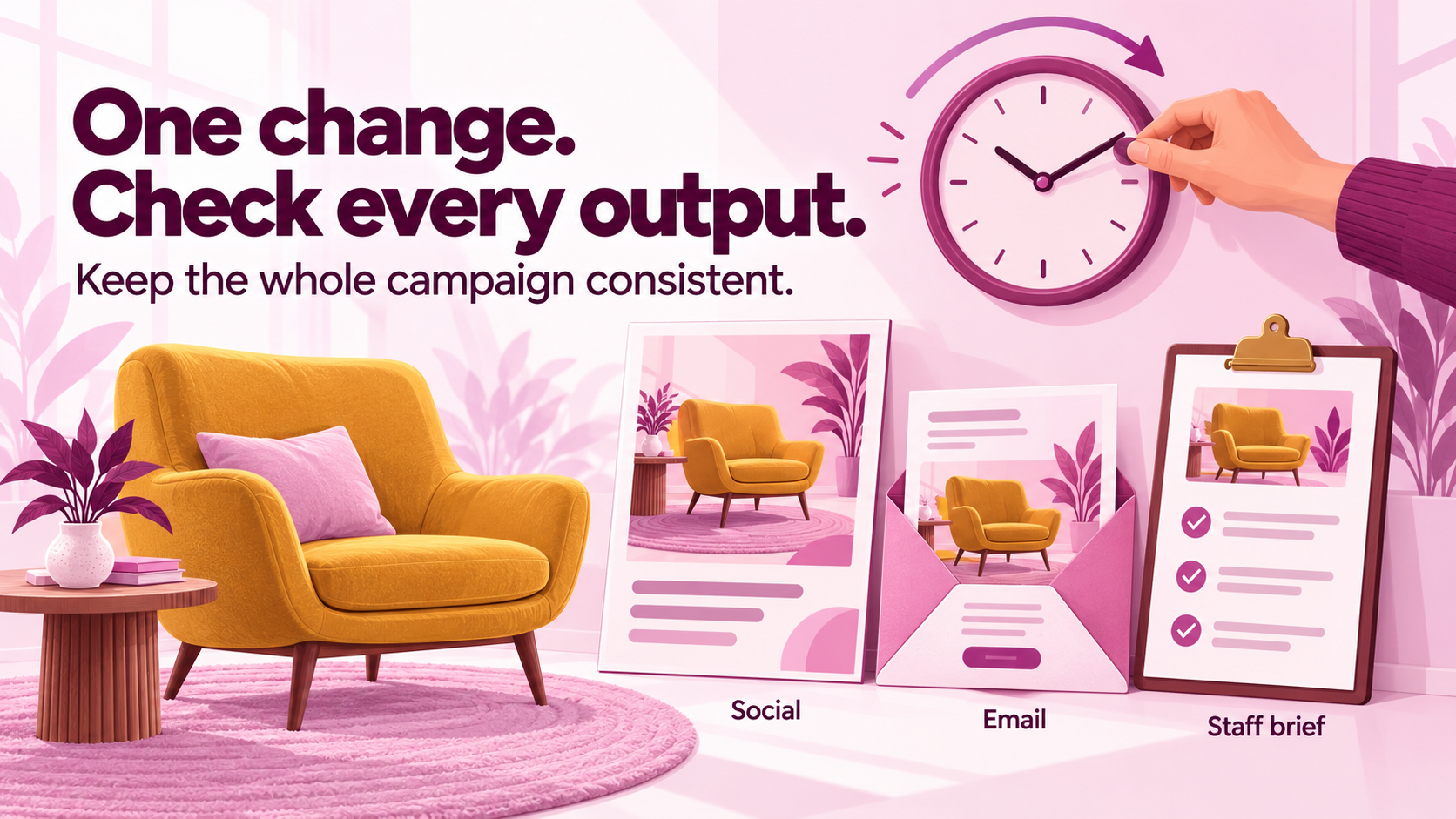
Provide the same source pack for every task: event date, address, opening hours, eligible products, approved offer, product photographs and the booking link. State that missing details must be flagged rather than invented.
|
Job |
Example starting point |
What to inspect |
|---|---|---|
|
Three event posts |
Soshie |
Correct offer, distinct angles and readable creative |
|
Invitation email |
Emmie or Penn |
Clear subject, accurate details and a usable call to action |
|
Customer-question drafts |
Cassie |
Answers supported by the supplied policy and event facts |
|
Staff briefing |
Vizzy or Buddy |
A concise checklist with responsibilities and missing decisions |
|
Follow-up analysis |
Dexter, with supplied results |
Accurate interpretation of the actual data |
These assignments illustrate how an owner might organise the brief; they are not a claim that every connected action has been verified.
Next, change one detail: the event starts an hour later. Ask for the affected materials to be revised, then inspect every output. Check whether the email, post artwork, captions and briefing all agree.
Finally, separate content that is ready for review from content that has actually been scheduled or sent. Keep a simple record of the remaining steps and who owns them.
Editorial insight: The revision is often a more revealing buying test than the first draft. It shows whether you can maintain a consistent campaign when the business changes its mind, which is a normal part of marketing work.
What are the strengths and trade-offs?
The role-based structure gives a busy owner an understandable place to begin. Shared context can make that structure more useful, while documented publishing and recurring-task features expand the product beyond writing assistance.
The trade-off is that you still need to understand what each task requires. Broad coverage does not remove the need to check facts, account permissions, output quality or completion.
|
Potential strength |
What remains your responsibility |
|---|---|
|
Recognisable helpers for different jobs |
Choosing a suitable task and clear success criteria |
|
Shared business knowledge |
Maintaining accurate, current information |
|
Supported automation and publishing |
Checking the relevant action and final status |
|
A broad range of business uses |
Deciding whether you will use enough of that range |
|
Choice of subscription terms |
Assessing actual usage before committing |
We have not measured Sintra's reliability, customer support quality or output consistency in this assessment. Those questions need direct testing and evidence across a meaningful period; a feature page cannot answer them.
Customer reviews may help identify questions to investigate, but a complaint or a positive testimonial is not a substitute for checking your own workflow. Record any problem reproducibly, including the task, account setup and result.
Sintra or Purple+: which approach fits?
Sintra may suit an owner who wants a collection of assistants for wider business work. Purple+ focuses on marketing across social, advertising, SEO content and email, with an optional managed service for businesses that want human delivery support.
Both can be relevant to marketing. The choice should follow your required work and preferred way of managing it.
|
Decision |
Sintra |
Purple+ |
|---|---|---|
|
How work is organised |
Named helpers across business functions |
A marketing conversation and connected workspace |
|
Main scope to evaluate |
Business assistance, including marketing |
Recurring marketing across supported channels |
|
Brand context |
Brain AI |
Brand-aware marketing workspace |
|
Social publishing |
Documented Soshie creation and scheduling |
Drafting, review and publishing through supported connections |
|
How you want to work |
Helper interfaces and supported automations |
Directly, or through a compatible connected AI assistant |
|
Human delivery support |
Assess the service you need separately |
Optional Purple+ Managed, separate from software |
This compares published approaches, not the quality of identical test outputs. Neither column guarantees that your particular account or desired format is supported.
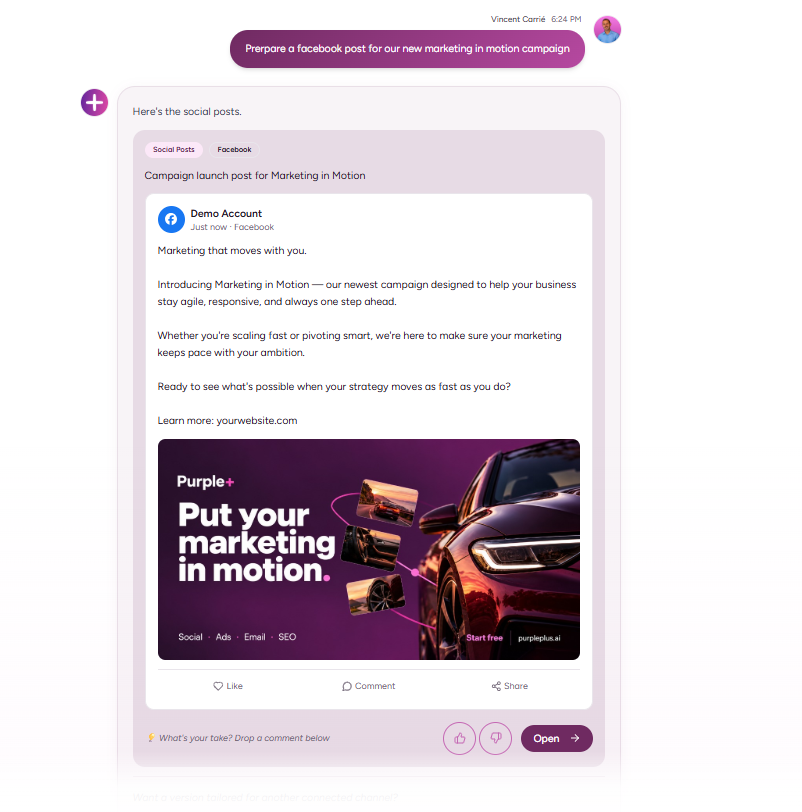
For the furniture shop, a Purple+ evaluation could begin with the same event brief and ask for the marketing assets to be prepared for review. Check the finished materials, amend the event time and confirm the publishing status before expanding the work.
Compare Purple+ and Sintra if you want to examine the marketing fit in more detail. If your main difficulty is finding someone to coordinate production and approvals, explore Purple+ Managed as a separate service decision.
Is Sintra AI worth it for your business?
Sintra is worth evaluating if you have recurring tasks across several business functions and want an accessible way to brief AI helpers. Its documented memory, integrations and automations give it a broader proposition than a set of writing prompts.
Make the buying decision with a small collection of real tasks. Check the output, required corrections, connected actions and total usage before choosing a longer subscription. You should finish the evaluation knowing which jobs become easier and which still need your time.
If marketing is the work you most need to get organised, compare the same campaign in Purple+. Choose the workflow you can keep using when the offer changes, someone requests a revision and the next deadline is already approaching.
Frequently asked questions
Written by
Founder & Director
Vincent Carrié is the Founder & Director of Purple Media, a full-service digital marketing agency in Gibraltar working with brands including Holland & Barrett, Vitabiotics, and Gibtelecom. Drawing on years of hands-on campaign experience, he's building Purple+ — an AI marketing agent that creates and publishes brand-aligned content across social, paid ads, SEO, and email from a single chat. He writes about applying AI to real marketing workflows, with a focus on what actually drives results for solopreneurs, SMBs, and agencies.