
10 Insider Secrets to Rapidly Grow Your Email List and Increase Sales with AI

Growing an email list is only valuable when subscribers are interested in what a business sells. A large database of inactive contacts will not generate consistent sales, while a smaller list of relevant prospects can become a reliable source of leads and revenue.
AI can improve email list growth at several stages. Businesses can use it to research audience needs, create lead magnets, optimise sign-up pages, segment contacts, personalise campaigns and identify sales opportunities. Email automation then connects these activities and delivers relevant messages based on subscriber actions.
The following 10 tactics show how to use AI to attract potential customers, increase subscriber conversion and generate more sales from email marketing.
1. Use AI to Find Lead Magnet Ideas That Attract Potential Customers
A lead magnet is a free resource that visitors receive in exchange for subscribing to an email list. It can be a checklist, template, calculator, industry report, webinar or downloadable resource.
The best lead magnets solve problems potential customers already want to address. AI can help identify those problems by analysing customer questions, product reviews, search queries, support enquiries and existing website content.
For example, a marketing software company could analyse questions about campaign planning, social media scheduling and advertising performance. If its audience frequently struggles with campaign organisation, it could create a downloadable campaign planning template.
Use AI to:
-
Group customer questions into recurring topics.
-
Identify problems related to your products or services.
-
Analyse search queries and related questions.
-
Compare lead magnet formats for different audience segments.
-
Prepare outlines and draft content for downloadable resources.
The connection between the resource and the product matters. A social media planning template is likely to attract more relevant prospects for a marketing platform than a generic business productivity checklist.
Measure the results by tracking downloads, confirmed subscriptions, subsequent engagement and purchases. A lead magnet that generates fewer but more relevant subscribers may deliver better commercial results than one that attracts a large volume of unrelated contacts.
2. Create AI-Optimised Landing Pages for Email Sign-Ups
A landing page converts interested visitors into email subscribers by presenting a specific offer and a clear reason to register. Its headline, benefits, form and call to action should explain exactly what the visitor will receive.
AI can help create and test different landing page messages for specific audiences. Instead of using one generic subscription offer, a business can adapt its message to the visitor's interests or the topic that brought them to the page.
For example, a company selling marketing software could create different landing page versions for:
-
Agencies looking for a campaign planning template.
-
Small businesses interested in email marketing.
-
Ecommerce companies looking to improve customer retention.
-
Marketing teams that need to coordinate several channels.
AI can prepare alternative headlines, benefit statements, calls to action and frequently asked questions. Marketers should then test these versions against actual sign-up rates.
A useful landing page should include:
-
A headline that describes the resource or benefit.
-
A short explanation of what subscribers receive.
-
A clear call to action.
-
A simple sign-up form.
-
Information about email frequency and subscription expectations.
-
An appropriate privacy notice.
Do not judge landing page performance by the quality of AI-generated copy. Compare visitor-to-subscriber conversion rates and the quality of the contacts acquired.
3. Improve Email Sign-Up Forms with AI and Conversion Data
A sign-up form should collect enough information to support relevant communication without making registration unnecessarily difficult. Long forms can discourage visitors, particularly when the offer is a simple newsletter or downloadable resource.
AI can help analyse form performance across different website pages and traffic sources. It can also suggest changes to form headlines, field labels, calls to action and placement.
Test specific improvements:
-
Remove fields that are not needed at registration.
-
Match the sign-up offer to the page topic.
-
Use a benefit-led form headline.
-
Test different calls to action.
-
Place forms near relevant content.
-
Make the subscription process easy to complete on mobile devices.
For example, someone reading an article about paid advertising may be more likely to subscribe for an advertising budget template than for an unrelated general newsletter.
AI can suggest different form variations, but the business should measure completed registrations and subsequent subscriber engagement before adopting them.
4. Segment Your Email List with AI
Email segmentation divides subscribers into groups based on their interests, behaviour, preferences or customer status. It lets businesses send relevant campaigns instead of sending identical messages to every contact.
AI can analyse available subscriber data to identify patterns in engagement, website activity, purchases and campaign interactions. These insights can help marketers create more useful audience segments.
Common segmentation criteria include:
-
Products or services viewed.
-
Previous purchases.
-
Lead magnets downloaded.
-
Website pages visited.
-
Email links clicked.
-
Customer lifecycle stage.
-
Stated interests and preferences.
For example, an online retailer could separate first-time subscribers, repeat customers and visitors interested in a specific product category. Each group could receive different product recommendations and promotional messages.
AI-based segmentation is useful only when the underlying data is accurate. Businesses should use lawfully collected information, respect subscriber preferences, and avoid treating inferred interests as confirmed customer preferences.
5. Personalise Email Campaigns with AI
Email personalisation adapts messages to the recipient's interests, previous interactions or position in the buying process. Using a subscriber's first name is basic personalisation; sending information relevant to their needs is more valuable.
AI can create different email versions for audience segments, suggest product recommendations and prepare alternative subject lines and calls to action.
For example, a software company could send different onboarding campaigns to subscribers interested in social media management, paid advertising or SEO content. Each campaign would explain the features and use cases most relevant to that subscriber's stated interest.
AI can support:
-
Segment-specific email copy.
-
Product and service recommendations.
-
Subject line variations.
-
Behaviour-based follow-up messages.
-
Different calls to action for different audience groups.
-
Content adapted to customer lifecycle stages.
The most useful AI email marketing tools connect campaign creation with audience segmentation and performance analysis. Purple+ supports email marketing through Mailchimp and Brevo integrations, with AI-assisted segmentation, campaign drafting and A/B testing.
Personalisation should not rely on inaccurate assumptions or excessive use of personal information. Every recommendation should be relevant, and campaign content should remain consistent with the subscriber's expectations.
6. Automate Email Sequences to Turn Subscribers into Customers
A new subscriber may need several interactions with a business before buying. An automated email sequence delivers relevant messages at predefined intervals or after specific actions.
AI can help prepare email content, adapt messages for different segments and analyse campaign performance. Automation software manages the delivery schedule and triggers.
A basic lead-nurturing sequence might include:
|
|
Purpose |
Example content |
|
Welcome email |
Confirm registration and deliver the promised resource |
Download link and introduction |
|
Educational email |
Address a relevant customer problem |
Practical advice or a useful explanation |
|
Solution email |
Show how a product addresses that problem |
Features and use cases |
|
Proof email |
Reduce purchase uncertainty |
Case study or verified customer feedback |
|
Sales email |
Encourage a purchase or enquiry |
Relevant offer or next step |
The sequence should reflect the subscriber's buying stage. Someone who downloads a beginner's checklist may need educational content, while someone who requests a product demonstration may be ready for a more direct sales conversation.
Marketing automation software helps coordinate recurring campaign activities and workflows. Businesses should define the triggers, timing and conditions for each message, then review the sequence against engagement, unsubscribe and conversion data.
Avoid sending the same sequence to every subscriber regardless of their actions. A customer who has already purchased should receive different communication from someone who is still evaluating the product.
7. Turn Existing Content into Email Subscribers with AI
Existing website content can attract new subscribers when businesses connect useful information with relevant subscription offers. Blog articles, research, webinars, videos and downloadable resources can all support email list growth.
AI helps repurpose existing material into new formats and identify topics that could become lead magnets.
For example, a company with a popular article about email marketing could create:
-
A downloadable campaign planning template.
-
A checklist for preparing newsletters.
-
An email course about audience segmentation.
-
A webinar on improving campaign conversions.
-
A report analysing common email marketing mistakes.
Each resource should offer something useful beyond the original article and give readers a reason to subscribe.
AI can also turn one approved content asset into several promotional formats. A detailed article can become a newsletter, social media posts and short educational content that direct interested visitors to the relevant subscription page.
A content calendar can help coordinate content production and campaign activities, keeping lead magnet promotion connected with the topics being published across marketing channels.
Track which articles and resources generate confirmed subscribers. This helps identify content that attracts visitors genuinely interested in the business.
8. Use AI and Paid Social Campaigns to Attract New Subscribers
Organic content can generate email subscribers, but paid campaigns can bring a relevant offer to a larger, targeted audience. AI can help prepare advertising copy, creative variations and campaign messages for different audience segments.
For example, a business offering a free e-commerce retention checklist could run a campaign targeting relevant business audiences. The ad would explain the resource's value and direct interested users to a subscription page.
Facebook and Instagram also support lead generation through native lead forms. With Meta Ads management, businesses can create campaigns and lead ads that collect enquiries through Meta's Instant Forms, without requiring users to visit a separate landing page.
AI can assist with:
-
Generating alternative ad headlines and descriptions.
-
Creating variations of advertising copy.
-
Preparing creative concepts for different audiences.
-
Matching campaign messages to lead magnet offers.
-
Reviewing campaign performance.
A paid campaign should be assessed by the cost and quality of acquired subscribers, not just impressions or clicks. Check whether the contacts confirm their subscriptions, engage with subsequent emails and eventually become customers.
Make sure lead collection and follow-up comply with applicable consent and privacy requirements.
9. Test Email Subject Lines and Campaign Content with AI
An email subject line affects whether a recipient opens a message, while the email content influences clicks and conversions. AI can generate alternative versions of both, helping marketers test different messages without writing every variation manually.
For example, a campaign promoting a free email marketing template could test:
-
A subject line focused on the resource.
-
A subject line describing the problem it solves.
-
A question related to the recipient's challenge.
-
A subject line highlighting a specific benefit.
AI can also prepare variations of email introductions, product descriptions and calls to action.
Measure campaign performance using:
-
Delivery and bounce rates.
-
Click-through rates.
-
Conversion rates.
-
Unsubscribe rates.
-
Spam complaint rates.
-
Revenue attributed to the campaign.
Open rates can be affected by privacy features and automated email activity, so they should not be treated as the only measure of campaign success. Clicks, conversions and revenue provide stronger evidence of commercial performance when tracking is configured consistently.
AI can suggest which variations to test, but actual campaign results should determine which messages perform better.
10. Use AI to Identify Subscribers with Purchase Potential
Subscriber behaviour can reveal interest in particular products, potential sales opportunities and reasons why contacts have not converted. AI can analyse available engagement and customer data to help identify useful follow-up opportunities.
For example, a software company may notice that some subscribers repeatedly click links about a particular feature but have not started a trial. The marketing team could send them a product explanation, relevant case study or demonstration offer.
Other useful applications include:
-
Identifying subscribers with repeated interest in a product category.
-
Finding existing customers who may need complementary products.
-
Detecting declining email engagement.
-
Identifying leads who need more product information.
-
Comparing email engagement with actual purchases.
-
Preparing targeted re-engagement campaigns.
These signals indicate potential interest, not guaranteed purchase intent. A subscriber who clicks several emails may still have no intention of buying.
Use AI analysis to prioritise relevant communication, then measure the resulting enquiries, purchases and revenue. Avoid excessive follow-ups that can increase unsubscribes and damage sender reputation.
How to Measure Email List Growth and Sales
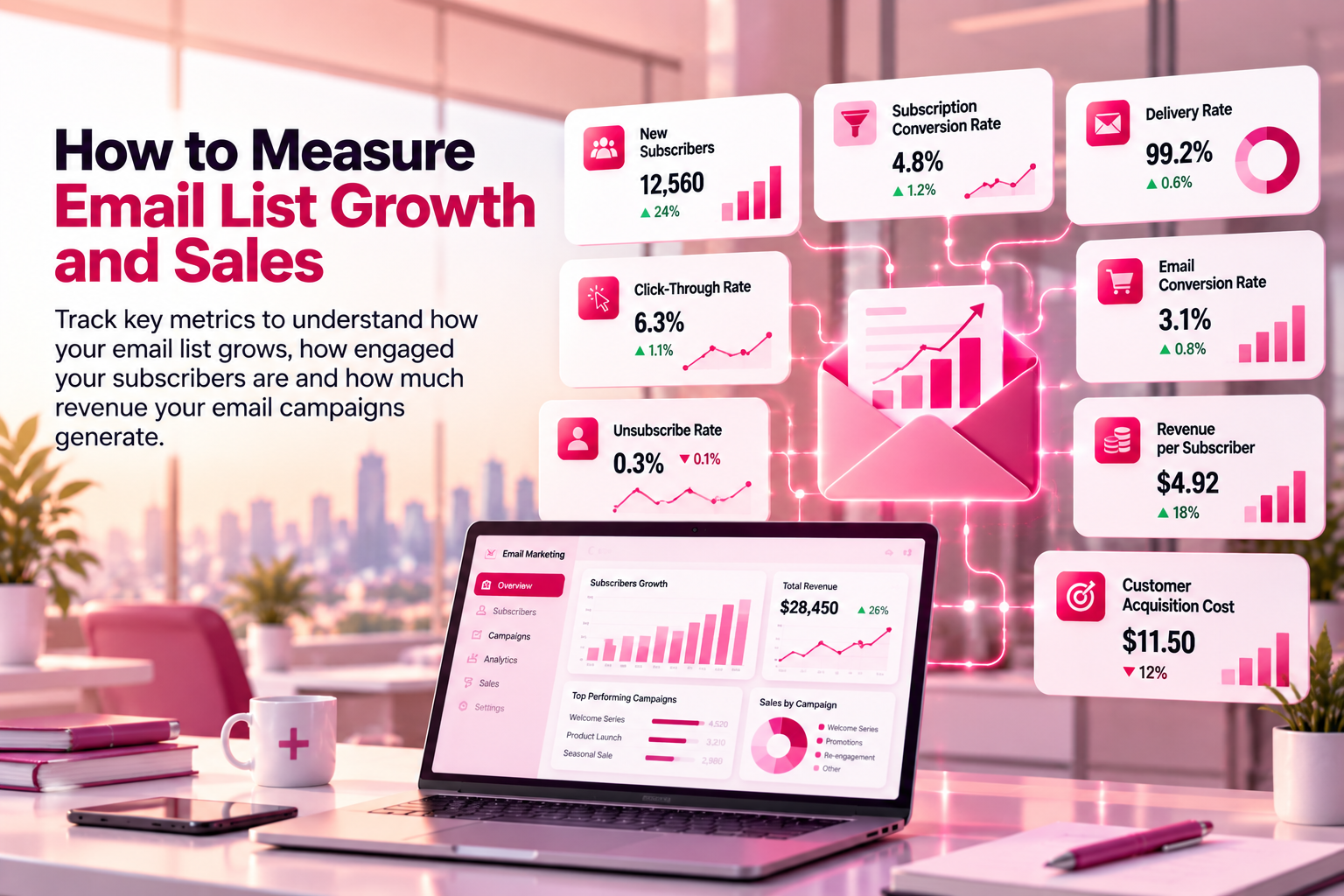
Email list growth should be measured alongside subscriber quality and revenue. A campaign that attracts many contacts but generates few clicks or purchases may not be commercially effective.
Track these metrics:
|
Metric |
What it measures |
|
New subscribers |
Number of contacts added during a period |
|
Subscription conversion rate |
Percentage of landing page visitors who subscribe |
|
Net list growth |
New subscribers minus unsubscribes and other removals |
|
Delivery rate |
Percentage of sent emails successfully delivered |
|
Click-through rate |
Percentage of delivered emails that receive a click |
|
Email conversion rate |
Percentage of recipients who complete the intended action |
|
Unsubscribe rate |
Percentage of recipients who unsubscribe |
|
Revenue per subscriber |
Revenue attributed to the email audience |
|
Customer acquisition cost |
Cost of acquiring customers through the relevant campaign |
For sales measurement, track purchases and revenue attributed to email campaigns. Use a consistent attribution method because customers may interact with several channels before purchasing.
Compare results across lead magnets, landing pages, audience segments and email sequences. This identifies which acquisition sources generate subscribers who actually engage and buy.
How Purple+ Supports AI-Powered Email Marketing
Email list growth involves several connected activities: attracting visitors, creating subscription offers, preparing campaigns, segmenting contacts and analysing results. Managing these tasks separately can make it difficult to maintain consistent messaging and track campaign performance.
Purple+ connects AI-assisted marketing with email, social media, paid advertising and SEO activities. Its email capabilities integrate with Mailchimp and Brevo, letting businesses work with connected email platforms while using AI to support segmentation, campaign drafting, and A/B testing. Businesses can also use Purple+ Managed for marketing support that includes email campaign concepts, copy, subject lines and performance review.
The objective is to connect subscriber acquisition with measurable business outcomes: relevant contacts, campaign engagement, enquiries, purchases and revenue.
Frequently asked questions
Written by
AI & SEO Content writer
Tetiana Reusche is an SEO Content Strategist and AI marketing specialist who specialises in creating content that helps businesses improve their online visibility and turn organic traffic into business growth. Her work combines search strategy, content marketing, and AI-driven optimisation to produce content that performs across search engines, answer engines, and modern AI-powered discovery platforms. Over the years, she has developed SEO strategies and content frameworks for companies in the SaaS, software, miltech, travel, real estate, home renovation, lifestyle, and entertainment industries. She enjoys translating complex topics into practical, engaging content that is valuable for both readers and search engines. Tetiana focuses on building topical authority through strategic keyword research, content planning, search intent analysis, and well-structured content ecosystems. She regularly creates keyword clusters, content recommendations, editorial roadmaps, and SEO strategies that help brands reach the right audience, strengthen their authority, and generate meaningful business results. Her articles explore SEO, AI-powered marketing, social media management, content strategy, and digital growth, with a practical focus on helping businesses create discoverable, useful content designed to convert.